


Update 1: GMT -7 1:51 pm 12/5/2024
I discovered a tagging fault; HUMAN ERROR DETECTED. I had auto-tagged the majority of the 3d and 3d artwork tags at the top of the image rather than the end of the image, which caused the outcome to be considerably weaker than anticipated.
The new suggested positive prompt is this
3d, 3d \(artwork\), realistic,
artist1, artist2, artist3, ... artist99,

noob tags here,

very aesthetic, aesthetic,
masterpiece, highres, absurdres, newest, 3d, 3d \(artwork\), realistic,
produces better results than the alternative in many resolutions, and the art styles pop more.
Clearly my process needs work, but that's fine. We take what the universe gives.
Whyyyy so serious Batman?
This is highly successful as a style, even with none of the special depiction tags.
Suggested Configuration:
Strength:
0.8 ePred
0.92 vPred
Steps 50
Euler - SGM Uniform
CFG 5-6.5
1024x1024, 1216x1216, 1216x832, 832x1216
832x832, 768x768, 512x768, 768x512, 512x512
Positive Prompt:
3d, 3d \(artwork\), realistic,

normal tags here,

masterpiece, highres, absurdres, newest, 3d, 3d \(artwork\), realistic,
Negative Prompt:
nsfw, worst quality, old, early, low quality, lowres, signature, username, logo, bad hands, mutated hands, mammal, anthro, furry, ambiguous form, feral, semi-anthro, bad anatomy, extra digitsRemove negatives or positive pieces to your hearts content.
Post burndown I noticed many high quality 3d images were tagged "disgusting" "displeasing" and "very displeasing", so keep in mind you might get good results using those three, especially when using lower resolution images than 1024x1024.
This style lora will produce many artist styles and series styles. It enhances many characters and fixes the base costumes of some as a byproduct. It introduces some new characters but not with enough strength to matter, so don't expect much from that.
This is particularly trained as a NUDGE lora. It's meant to shift the model, but not destroy it. To condition and improve it without introducing any major new information.
This means including images from many styles and many artists; strengthening the core "3d", "3d (artwork)", and "realistic" tags; without entirely destroying them.
There are definitely some depth faults, where when you hit a complexity level high enough the overlapping and problems start to artifact, and this is likely due to the upscale and sharpen methodology I used when sourcing images with intentional interpolation.
The next will likely be a 100k image version ran at least 20 epochs, so be on the lookout in the coming weeks.
In the coming days I'll be researching AI Refinement, image interpolation and motion AI technologies, as well designing a transitional-phase LORA that I call RE-LORA, which would be a burn-in refinement LORA concept; based entirely on imprinting conditioning and image refinement information at a much higher learn rate and less steps specifically targeting positions using a frozen model iterated at those positions, rather than destroying or altering core models, or waiting for entire full-end epochs.
It's akin to a lora and akin to a text_encoder but it is neither of them. The goal here is to burn kind of, scars on the model to tell it where it's own data is, using a compacted high dimensional storage tensor. It's more akin to forcing img2img into it, sketch, or even enabling masked inpainting in already existing models without large training cycles and very minimal required image and mask data.
Unsorted Musings:
Looks like it works on ePred V1.1 as well, just a different measure of scale.
It works SURPRISINGLY good with ePred v1.1, but was trained using vPred v0.65S as the base model.
Seems to support 1300x1300 with additional upscaling if you use 2m SDE Heun. Comes out really really good.
Give it a try.
quarter-frame is not small enough, and it was far more effective than I thought it would be.
I'll need to run identification again and this time make sure there's an even smaller tag, something like small-frame for 1/9th of the image.
Epoch 30 has even better depiction control, with a higher fidelity in realism and 3d. Far superior to the epoch 20 and yet still incomplete.
For epoch 37 I'll create a full image display roller and a bunch of use cases for the various taggings.
About 4000 images sliced from videos and 6000 images taken from the most recent r34xxx and r34us uploads.
Give or take 10k images, trained to 20 epochs at a batch size of 64 on 2 A100s.
The estimated training completion for epoch 37 is about 7 hours, so expect couple more uploads.
An experiment based on images sourced from animated gifs and videos in combination with sourced high resolution non ai generated images.
It has many 3d artists that are likely lesser represented, and many 3d artists that I'm sure are very popular.
Every image was identified to have at least one person.
I'm currently compounding a full list of artists. I honestly didn't hand pick much, it's pretty automated. Check the recent article for more details.
I'm inspired to train a full 100k image version of this.
I'll capture each frame of each video, document interpolation normalization differences from frame to frame for sharpening, posterity, and utility; as well as a frame by frame tagging counter.
This will enable full interpolative video generation in a MUCH MUCH more stable manner.
For now, it's just a stylized tinker toy with some depiction offset tags. Enjoy!
Depiction Tags:
depicted-upper-left
depicted-upper-center
depicted-upper-right
depicted-middle-left
depicted-middle-center
depicted-middle-right
depicted-lower-left
depicted-lower-center
depicted-lower-right
Scale Tags:
full-frame
half-frame
quarter-frame
Aesthetic Tags:
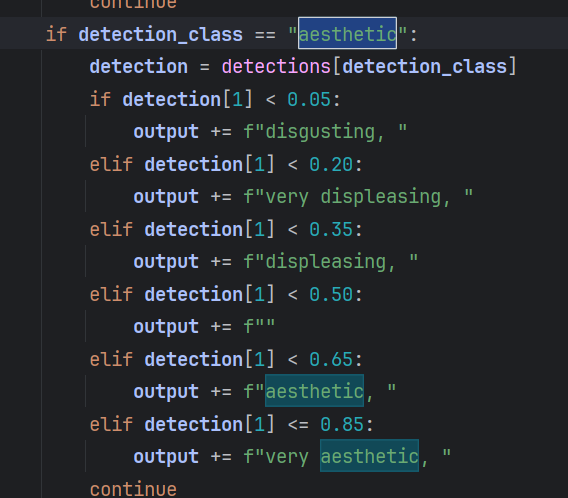
Use like this:
depicted-upper-left half-frame face
depicted-lower-center full-frame legs
You'll be able to get many interesting outcomes with tags I did not train, due to the model itself recognizing the offset and depictions based on focal points in the sourced images.
Description
Superior control over epoch 20 of people and objects.
FAQ
Comments (13)
How did you solve removing motion blur from the extracted frames? I attempted to do something like this a few months ago. Having OpenCV try to detect the least blurry frames within a given segment and isolate them was the route I went with, though it was still only moderately successful. Would love to know a bit more about your workflow if you are willing to share. I have some loras I would love to train using some SFM and Blender renders. Having the cleanest dataset possible would really help. Thanks.
You have to interpolate between the two surrounding frames, sometimes more if the motion is drastic, and then upscale sharpen. It can introduce artifacts and I did notice a few in the post training data review, but it's nothing major to phone home about.
I just posted another comment with a link to the slicer, but that's not going to give you the complete interpolation picture. I use a multi-tiered system.
@AbstractPhila Seems like a great starting point, thanks for the share. My goal really is just to obtain the clearest frames from the video within a certain threshold. The rest is pretty much solved for my needs.
@marviskealan254 You'll want to upscale and sharpen. You can reduce a great deal of artifacting and problems by using a simple upscaler. Additionally you can use deepghs's imgutils to identify the level of noise, erroring, and so on. They're quite potent as a set of tools for identification and detection.
https://github.com/deepghs/imgutils
Narugo is quite friendly.
@AbstractPhila Perfect, this looks extremely useful. For upscaling and noise cleanup I was experimenting with CCSR and SUPIR. CCSR did a much better job, it just hogged more then 24GB of vram and took a couple minutes per frame so it was not ideal in that sense. As well is it does seem to alter fine details such as facial features (lip, nose, eye, shape for example.) It was subtle, but still there, so I have been hesitatant using it to process the trove of frames I have already extracted and was hoping to find something better. Which upscaler did you well in regards to 3D content?
@marviskealan254 I actually removed faces entirely for about 10% of the images, and blurred the rest of the faces with prime number seeded noise, so only about 50% of the overall image structure FROM VIDEO INTERPOLATION had functional faces. NoobXL handles the majority of the fill-in for those.
However, the 6k images I sourced from r34 had a bunch of nearly identical artist tags matching the videos, so I'm teaching it those faces in the process. The entire process worked quite well on a low learn rate.
@marviskealan254 Here's an idea. Sample and separate the least blurry frames, and then use those for regularization images with a lower strength. That would provide a bit of stability to the otherwise blurry mess of some low quality videos that don't upscale very well. I had to discard a few because their pixel count was too low to reasonably upscale.
@AbstractPhila That's a pretty good idea Ill give that a shot, most of the videos I pulled apart are thankfully 1080p or higher, so that is less of an issue for me. I have to upscale by 2x at most sometimes.For the few 720p ones that I have. I have been using the foolhardy_remacri 4x model for upscaling, I am just not a fan of it for 3D stuff.
@marviskealan254 You've inspired me to expand on my system even further and to make it even more robust.
I think the depiction tags and the r34 absurdres are carrying here.
@AbstractPhila Haha, glad I could help. Noob was trained on NL as well as danbooru and E6 tags, at least the Vpred versions. The NL training could explain why the depiction tags are working that well. Lax's discord has a ton of people throwing out big brain ideas, wouldn't hurt to keep an eye on that as well.
@marviskealan254 I find I work best when I'm hungry, which basically means I don't know what to do in many cases so I run a ton of experiments in sequence to figure it out. I often come up with different solutions to the other developers and researchers, and I often see my solutions show up in random places elsewhere.
I like to call it traveling unpaved roads.
We often end up the same places, but I like to take my own route and avoid cluttering my mind with other people's ideas.
Sometimes my route is a faster one, which helps people indirectly who look for it. Sometimes I get lost in the woods and I need a life line.
Today I think I'm making new roads in different directions. Only time will tell where they go.
If anyone is interested in the ACTUAL slicer script it's here, the internal mechanisms to make it multithreaded on the other hand aren't something I can just drag and drop. https://pastebin.com/vKQ3pmJv
It took me a bit to get all the logistics worked out, but it works okay. It's not optimized to the T yet, but it's not bad as a module.