


https://huggingface.co/AbstractPhil/clips/tree/main
https://huggingface.co/AbstractPhil/SD35-SIM-V1
If you have problems downloading or running them, you can hunt down the working versions on hugging face at my repo. I upload all of them there as well as here.
Operating the T5-Unchained
I believe I forgot to include the token weights layer, so I'll make sure each layer is correctly matching with parity for the next official release; my apologies for this version being imperfect, but the token weights CAN be acquired elsewhere.
This breaks the standard t5 while operating unchained mode, so keep a copy of your tokenizer and default config.
I have plans for making proper nodes to work with all this stuff on the weekend. I'll be making a full mockup of how they behave and their various linker points for engineering, development, testing, and debugging over the coming months.
The abs-clip-suite will be born this weekend. 4/12/2025-4/14/2025. I have already done a bit of ground work for node layouts but it's not ready for full development yet. This will be an iterative development process building the described nodes in my recent article.
If you're ABSOULTELY keen on using it before then, you can use it with this process. The not-so-easy process.
This isn't exactly simple yet;
Download the t5 version you want; fp8, fp16, bf16, whatever.
For comfy;
open comfy's entire folder using vscode
ctrl + shift + f vocab_length and find 37~~~ it's 30,000 something tokens it shouldn't be hard to find using the keyword vocab.
replace all of those configs with the t5xxl-unchained config.
Until my patches or official patches are implemented, this is how it must be done.
find every use of the t5 tokenizer in the various folders and replace them with the tokenizer in the t5xxl-unchained repo.
restart your comfy and run it
For forge;
Similar to comfy, open it on vscode and ctrl+shift+f all instances of vocab_length and replace the various config files with the t5-unchained config file.
replace the tokenizers as well; there isn't anything special code-wise that has to happen here, but it's a chore.
restart it, run the unchained.
What are... Clip Experts?
These are finetuned clips; allowing for more robust utilization of their parent models than average clips. They are trained with millions of samples each to additionally provide new data, augment old data, and create careful vectorized trajectories using that new and old data together.
Essentially... they are finetuned with a bunch of images and each is the expert in accessing routes for captions that otherwise would go completely overlooked; particularly when it comes to PLAIN ENGLISH.
What makes them different?
These clips are specifically tuned to the vpred refits of the models; but they don't necessarily conform to ONLY the VPRED models. These clips should merge directly, or indirectly with other clips from models in their same brand pool.
For example; NoobSim is based on the MOSTLY NOOB CLIPS; however, they were merged with the SimV3 SDE clips (Clip L Omega and Clip G omega 24 iterations), prior to partial or full conversion of their parent models to vpred.
I did not FEATURE infuse these clips in the way that I did their coupled UNETS when you get the entire model.
The unets were FULLY FINETUNED with the SAME EXACTLY DATASET after their infusion is complete. This can be finetuned in the standard methods, as the model leftover from the feature injection is a straightforward SDXL model with the student's configuration.
This gives them unique knowledge of both noise types based on a standard additive normalized merge, allowing for unique utilization that otherwise would not happen.
How can these even work how you say?
Yes it's well known that if you merge pony clips with standard sdxl clips; you get garbage noise on either model, usually resulting in a completely destroyed model.
However in this case, the models were directly infused with features of the other model, not in an additive, norm, subtraction, or whatnot style. I literally trained the models using the direct responses of the teacher model, implanting those direct responses into the student model.
You can see some semi-successful variations of those on my huggingface, but the big boys are already being finetuned as you can see here. They are the heavy hitters, the winners, the cream of the crop, the legitimate powerhouses that won the battle of the feature implantation.
What even is a feature? You keep saying that.
A feature, is a mapped trajectory route through the entire model from top to bottom based entirely on how long it took to get from point A to B, each neuron struck, and why those specific neurons were struck mathematically.
In essence, a feature, is the purest form of an algorithm, and them shits are big. Each feature layer capture is at least 2 megs of vram, accumulated upward per layer, in an exponential fashion, you end up with nearly 500 terabytes of feature data if you go from point A to B with ONE feature capture.
Welllll we can't fucking do all that can we, that's insane. It's akin to decrypting an image bomb so it won't explode without knowing the response that any of it's mechanisms will do, so you cannot possible capture THE ENTIRE response...
HOWEVER<<< we don't NEED the entire response. We need a trajectory, and we need to pass through each one at a time. So what we do, is during train time, we pass those same trajectories, and those response through the cached parent responses aka the routes and the expected outcomes, and then we determine the difference between those and the student. This is how we decide what to learn, and what NOT to learn.
FASTER means MORE LEARNED. This doesn't denote accurate however, but we aren't aiming for accuracy here, we are aiming for LEARNING!
So the faster the response, the better the outcome of the test, and therefore the more learned the task and route is.
Faster = better.
Okay, so we implanted these rules based on timings; we extracted sections of the neural net DIRECTLY during train time by using those valuations from the teacher and student to cross-correlate a difference using a simple logarithmic equation that I developed based on inverse cosine and the current timestep accessed.
Now, we determine the difference of those two features one layer at a time, and we accumulate those differences to determine WHICH differences we are to target with our next gradient accumulation trickle.
So now that we've identified each piece to train, we pass that directly through our difference mechanism, it hits each neuron one at a time to determine which is faster to which ask, and then once it's done poking both machines it learns the difference in a big fat tensor; that I call a feature.
What are you EVEN talking about?
Reverse inference. We are accessing what is there, by determine how quick it responds, and then taking the difference between the host model and this model; and then LEARNING THAT DIFFERENCE!
LITERALLY teaching one thing, the learned response of the other, DIRECTLY into it's neural pathways.
I call it feature grafting.
Okay!?!?!
Lets put it simply right. If we get the response of 1girl from one model 500 times in a similar neuron, the response of the other model will shift into that position slowly over time, and learning the difference between itself and that model.
The attention layers will slowly confirm to very specific routes, the dense nets will align, and the hidden layers will conform over time; however we can't simply SHOVE all this in, or you get incredibly incorrect responses. It has to be taught, like teaching a new form of math.
This, is a form of merger that is more akin to grafting and implantation than it is any traditional method.
In it's learn rate, it automatically saves SOME. It accumulates that difference at a HIGHER VALUE based on a few factors, and a secondary factor based on noise introduction similar to a direct inverse to which timestep and which locations are accessed at that time.
This prevents large scale destruction, while still allowing for the necessary features to be slowly implanted.
BASICALLY it learns less than it could, but more than it needs; causing the entire structure around A and B to shift.
It's really hard to describe it without showing the data and math.
Okay so why? Why make these?
You know all those features I was talking about? The algorithms, the routes, the paths? They are all being accumulated into a large pool of features. A massive database that is going to be used to train the difference machine that will allow all these features... to communicate together, using a different and yet well documented methodology based on LLMs. A very well paved road.
So when we teach this attention mechanism all these features, all these routes, and we force it to communicate to those mechanisms in a cross-correlative way using each, we can accumulate what I dub; a mixed diffusion feature model.
So if you think about it like, okay I'm going to ramp off Pony's 5313241341 neuron to Noob's 134134134th neuron, and then the system will automatically assume that you can ramp from that neuron to SDXL's 134314132th neuron; we can assume that each are simply LINKED now, rather than fully disconnected.
Now, at this point, we can combine all of them into a uniform object system, and trickle call each at the same exact time without disconnects or model barriers; allowing for a single packaged outcome with allllll the feature data captured and all the used neurons implanted into one single model meant to organize and delegate the others using a series of mathematical sliders based on the proofs and concepts that LLMS are built on; we can assume this will be the first of it's kind, a full-fledged mixture of experts using expert models that are already mixtures of experts, trained to withstand a series of different expert expectations.
The final goal here;
We take all 12 clips, we take all 6 sdxl models, and we mash them together like potluck at a picnic with an old boot sticking out of it.
Then we take all that potluck, and smack the smarted AI we can muster right on top like a hat. Likely going to use a form of LLAMA or MIXTRAL itself, hard to say right now, but this thing when it's ready, will be the first feature diffusion model that has basically been makeshifted out of duct tape and cardboard with toothpicks as a spine.
The attention shift mechanism;
There are a series of proofs based on this concept that I'll need to review. There are certain algorithms that I need to be sure will work how I need them to work; and if they do not I'll need to write and conform one based on the new need. There is a series of LLM-based attention mechanisms and the math to go with them that I need to review and fully understand from top to bottom, alongside the mechanisms for the various AI identification models I'll be including aka ; wd14 large tagger, anime/real, classification, and so on.
Each are meant to accumulate directly with the LLM itself, communication trajectory information based on the learned pathways and understanding of the tags on identification for IMG2IMG and ClipVision capability atop the current structure allowing for a full conserved identification process based on the learned features caption tokens and the set the system can cross-interpolate between each model.
As it stands it looks like the T5 unchained might be the target, but the HunYuan LLAVA is also a top contender, but only because it has a huge vocabulary and is multi-language.
The first version will only have a token vocabulary of nearly... let me see... I think it's around 4 million? So that's pretty good, but I don't think most of them will have the information they need to actually be useful, so that's where the LLM is going to need to condense to maybe less than 60k, otherwise it's going to be absolutely useless noise most of the time.
So there's still quite a few limitations with our current model that I'm working around, but suffice it to say, these are the experts that will be manning the ship.
TF did it do to the files? Looks like the BF and FP value somehow broke... the files? Like it renamed and gutted the config or something. I might need to upload as zips.
So forge can handle them but comfyui has trouble with the ones uploaded to civit. Grab the correct ones from the huggingface if you need them.
https://huggingface.co/AbstractPhil/clips/tree/main
If you have problems you can hunt them down here. I basically dumped all my clips.
Due to regular request and my neglect, many of the clips I've trained have gone completely under the radar.
I don't expect these to have many downloads as the site doesn't support CLIP as a natural extension, so I'm going to simply document and store them here. If you need them go for it.
Multiple uploads have multiple files; smaller one being CLIP_L larger being CLIP_G, and if it's 4+ gigs it's probably a T5.
CLIP_LG are mostly BF16, but I needed to set one to FP16 to get them on the same file list.
APPARENTLY it also gutted the names, so you'll have to rename them to CLIP_L and CLIP_G.
Bleh...
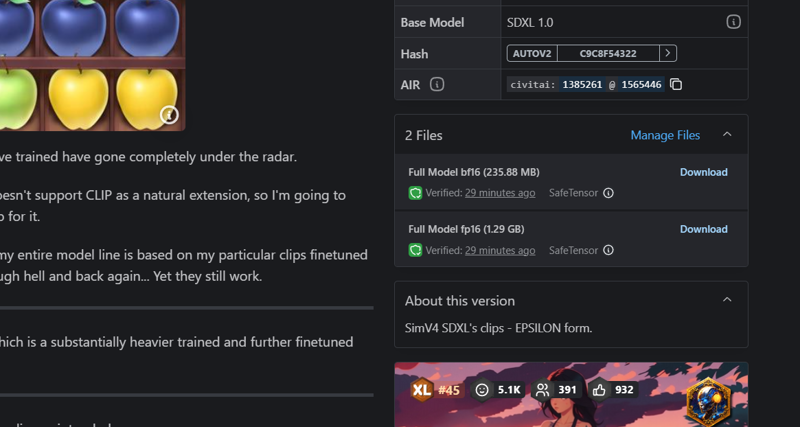
I'll be keeping a log for very specific clip trainings here; as my entire model line is based on my particular clips finetuned from the base CLIP_L and CLIP_G clips that have gone through hell and back again... Yet they still work.
The true (released) successor for Omega24 is 72 Omega, which is a substantially heavier trained and further finetuned version with 10s of millions of more samples as a pair.
Every major SDXL VPRED finetune has left a big mark on the clips as intended.
Even with VERY LOW LEARN RATE, they have heavily diverged into alternative routes; which I deem clip experts in their own fields.
They can be mixed and merged with mixed results when using other models, but keep in mind they are finetuned specifically for their parent model, so you will get mixed results based on what you're smashing together.
Description
FAQ
Comments (36)
how make it work on comfy ui ?
DualClipLoader
Are any of these CLIPs compatible with an SDXL photoreal like BigAspV2?
Dunno. I doubt BigAspV2 can be fixed, but it's worth a try.
@AbstractPhila So, if I'm reading this CLIP stuff correctly, I can introduce an image in the prompting process which will trigger a certain part of the model to steer the output direction toward a certain outcome?
Welllll... I could train a bigasp vpred I suppose. It's really only about a 2 day process.
@dookiemcdookieson231 Sim 24 omega, Sim 72 Omega, and Sim 73 Omega are likely your best chance to get BigAsp working with my clips. They are far less burned than the bigasp clips I think, but I haven't done much investigation into the bigasp clips.
Seems BigAsp is epsilon prediction, so using the vpred clips are likely going to be very hit or miss. Use the epred clips and you'll have better results.
It looks like bigasp's failpoint, was using multiple image palettes without tagging them specifically as palettes, multiple_views, multiple_angles, or whatnot. This seems to have overwhelmed the substructure and introduced incorrect behavior.
These SIM clips are trained to CONTROL the grid, so you can disable those by using the grid_lr, grid_ur, grid_ll, grid_lr in the negative prompt.
That should disable the majority of the multi-image system, however if that doesn't work also blacklist
"5x5 grid, grid_lr , grid_ur , grid_ll , grid_lr ,"
Contrarily you can put them in the POSITIVE prompt to CONTROL BigAsp.
Merge the clips from Simv4 EPRED (Omega 72 EPRED) with the clips from BigAsp at 50/50, and then merge the two models together for a solid experimentation.
@AbstractPhila Oh my goodness! That would be so amazing! BigAspV2 was, and still is, awesome when leveraged the right way.
@dookiemcdookieson231 Well my entire purpose with diffusion and vision models, and the whole point I am training them at all, is to provide control to these models; especially high effort models like BigAsp, so it's on the todo.
@AbstractPhila Are there bigasp clips already? I haven't found any, but you mentioned them. Are they on this site or HF?
@dookiemcdookieson231 The official bigasp clips are just attached to the model.
I've just extracted them and am playing with merges.
@AbstractPhila Is there a good workflow for something like BigAsp where I can introduce an image into the prompt using clip? I'm pretty new to CLIP use, sorry for all the questions.
Can you upload the BigAspV2 clip to HF for mixing?
@null I have a prototype ready. I'm injecting features currently on Collab. So, we'll see if it wants Pony, Noob, or just clean Sim.
I've extracted SOME Omega features. They are actually substantially different than PonySim, NoobSim, SimNoob, SimV4 epsilon, and Simv5 epsilon.
It's shocking how different really, but SDXL Omega is it's own beast now. It's far beyond the others, so it cannot be tamed in the same way.
In any case, I'm applying Omega features currently; and those features will be the cornerstones of how I train models in the future, since each of those features are extracted based on the clump of teachers rather than just one model.
This is going to give the best basis possible for a vpred transfusion using all the experts without having to train 5-7 models like before. I only USED 5 of the 7 I expected to need, but the outcome is absolutely stunning for Omega so the process works. BigAsp is as good of a target as any, so it's my next science victim slash experiment.
I actually suspect that this has less to do with feature interpolation, and more to do with my specific timestep training and the paradigms that are learned, shared, and derived in each model alongside each other in unison.
I'll need to recreate each experiment in the future for a full biopsy of each and recreation of the process to allow teaching other vision models properly using diffusion-style timestepping and noise injection via entire systemic features in a careful and controlled cross-model entropic fashion, but the outcome so far shows the direct interpolation of features using direct diffusion methodology (aka timestep in uniform timestep out on features and interpolation directly) between similarly trained models finetuning, using matching token patterns, seeds, variables, and inverse variables; to be the most optimal and fastest and cheapest semi-full flexible refit method I've found to date, thus I will continue making frankensteins.
@AbstractPhila I found your new asp model on HF. Is there benefit to using the CLIP files in that folder with it, or is the "prepared" model ok by itself?
@dookiemcdookiepants They're basically just packaged for now; they are already fairly capable together. I didn't interpolate them like the others as this won't be a student, it's going to be a full on vpred conversion. It should be fairly quick, since I have a pretty solid process for it.
@AbstractPhila Is AspOmega based on BigAspV1 and OmegaAspV2 is based on BigAspV2?
@dookiemcdookiepants They are both based on BigAspV2.
So OmegaAsp is the Omega UNET with the BigAsp CLIPS.
AspOmega is BigAsp's unet with the Omega CLIPS.
The idea here is; I'll finetune each of their center steps with the intentional noise type, and then use that as a merge point to full finetune.
The experiments show that this a viable potential option, so I'm going to try it out. It's a lot smoother and shorter than the route I chose before, so if it works we'll know soon enough. If this does not work, it will require a full interpolative injection; which can take up to 24 hours.
More than likely I'll need to swap the CLIP_L from the BIG_ASP as it seems to be completely burned and fairly useless, however the CLIP_L from OMEGA is in fact the choice and most powerful CLIP_L that I have in my list; so it is a viable option to fit the UNET.
They will both be trained with frozen clips using LOKR so they'll be ugly as hell. Then they will be downloaded, merged, and then trained with LOCON. This is usually a process I hide, because it's not something I want to showcase; but I think it's time I actually revel some of my processes so people can learn from them.
I will also be gathering features, which means I'll be able to finetune BigAsp into the second Omega distillation.
The plain English training is what drew me into this one. Having this level of plain English training adapted and distilled into the system would be powerful.
@AbstractPhila Hmm... So basically I should skip these HF-posted models for now since they're ingredients instead of a meal, and they might not work up to par as-is?
@dookiemcdookiepants If you want you can get them to play with the LOKR as they come out. Or just load the clips and checkpoint in comfyui.
It should be about 1 hour per epoch, so if you're interested in playing with the conversions; make sure you set the model to v_parameterization using the comfyui node. Then you will see the conversion in real time, with all the painful growing pains between.
The Omega clips already refitted BigASP with only 10000 images.
As predicted, the outcome is about a 16 meg lora and the entire model is refit.
@AbstractPhila Could you tame this beast for Pony?
https://huggingface.co/zer0int/CLIP-Registers-Gated_MLP-ViT-L-14
Its a gift week:)
@jeffreymarez765 I mean, I can try.
@jeffreymarez765 Looks like it has almost no training in terms of utility. It's only been taught basic stuff, so taming this thing isn't going to just be as simple as attaching it to a model. It just has no training.
@AbstractPhila I tried it with a pony checkpoint and greatly improved realism(i mean huge), but the backgroung was noise(mostly texture, textured wall).
I dont know, how it was trained, or the original openai.
@AbstractPhila Meanwhile, i tried many clipG of yours for pony, 72 is a bit untamable, but good. 73 is very tamable, but gives washed out skin textures.
@jeffreymarez765 I got it working with a multi-tiered merge using my other clips while treating the primary clip model as the VIT-L version.
So it works with BigAsp now.
@AbstractPhila Ok, bigasp guy is not me.
@jeffreymarez765 I'm a bit too tired to continue that tonight. I need to get some sleep.
@AbstractPhila good night
@jeffreymarez765 Well... Now they are.
what should i use for illustrious models like WAI?
Use the NoobSim. See if that one works.
Otherwise OmegaSim L+G should work... maybe. I dunno if WAN trained the text encoders or not.
NoobSim-EPRED-Ω-72_clip_g and clip_l
Works for any non-VPRED model of ILLU. And it works really good.
Tried it with CyberIllustrious_V3, way better than original CLIPs. Coherent image that with certain solvers/schedulers that basically everything I prompt in. Also that CLIP G is apparently "smart", like it actually gets what I mean with natural prompt.
@Mescalamba I restored the vision portion of both ViT-L and OPENCLIP ViT-G, so interrogation is possible.
@AbstractPhila Meaning you can feed them pictures and they will tell you what to prompt? I saw those models, pretty big.
@Mescalamba Yea it takes a minute though. Need to use clip-interrogator, so it can be time consuming. VIT-G is also an OpenClip apparently; which is one of the foundational problems of training these things with additional finetuning without destroying the vision portion.
I've been researching ways to trickle train them while training diffusion but I haven't made headway yet.
Details
Files
Available On (1 platform)
Same model published on other platforms. May have additional downloads or version variants.