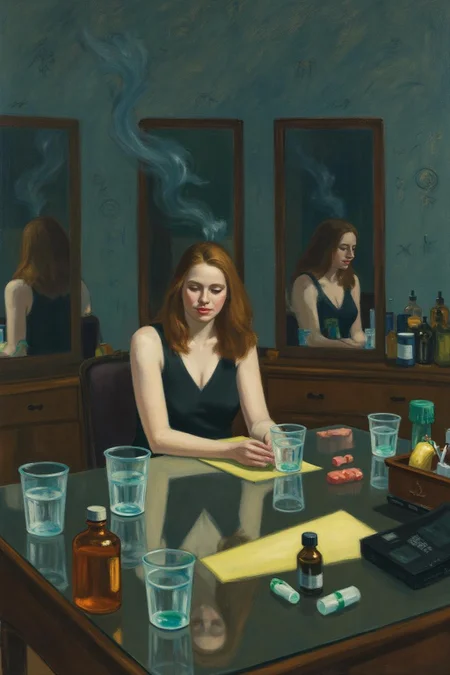
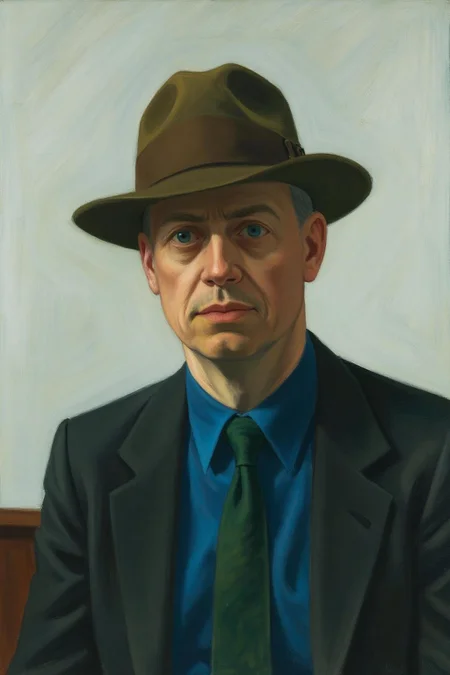
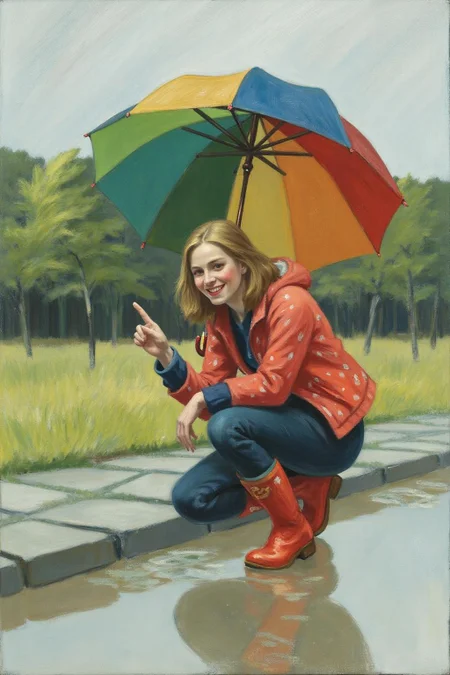
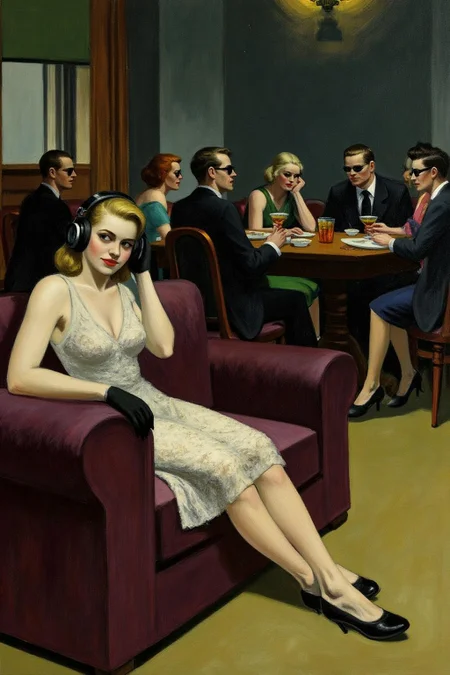
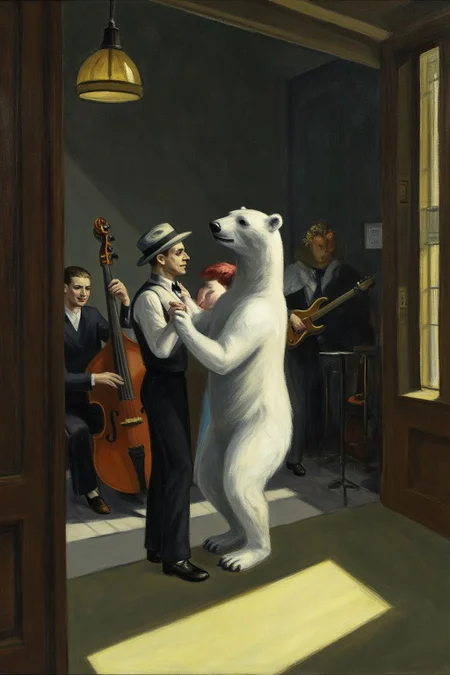
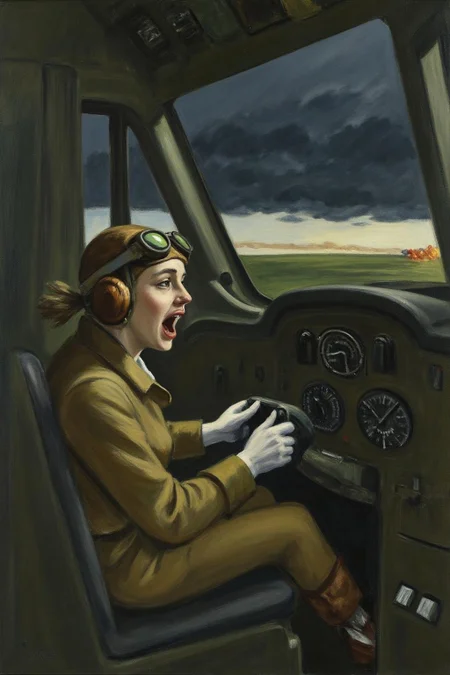
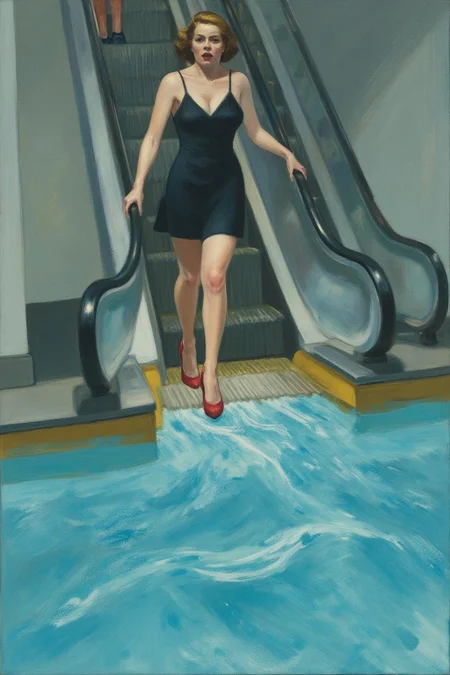
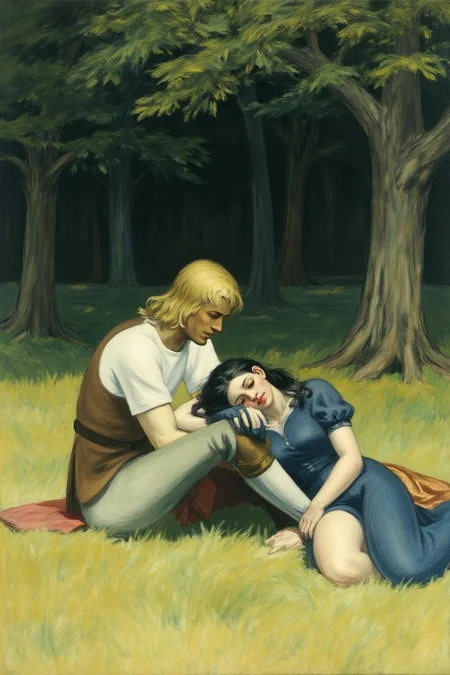
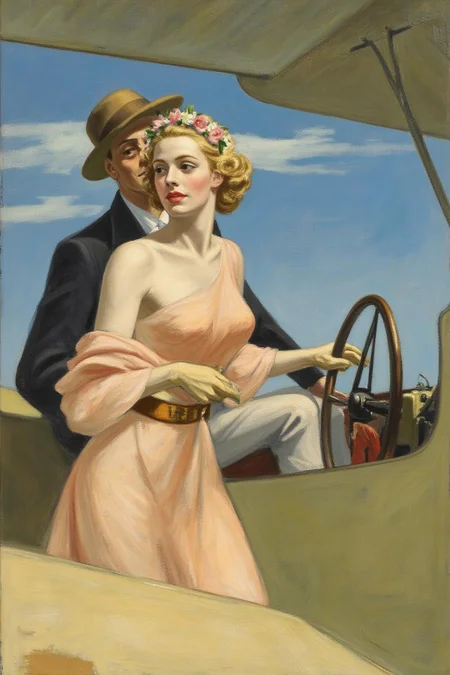
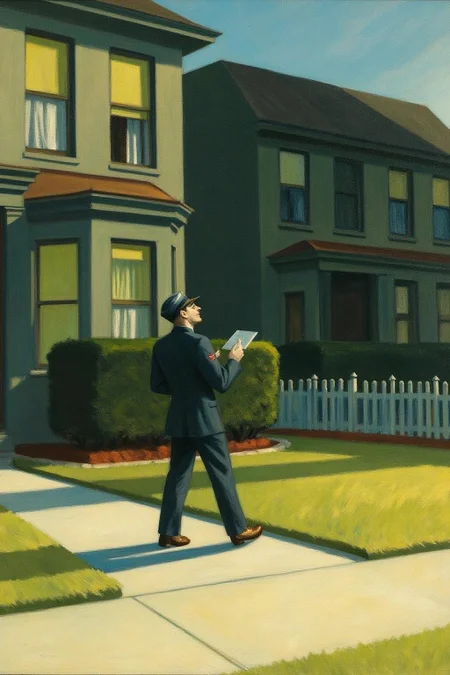
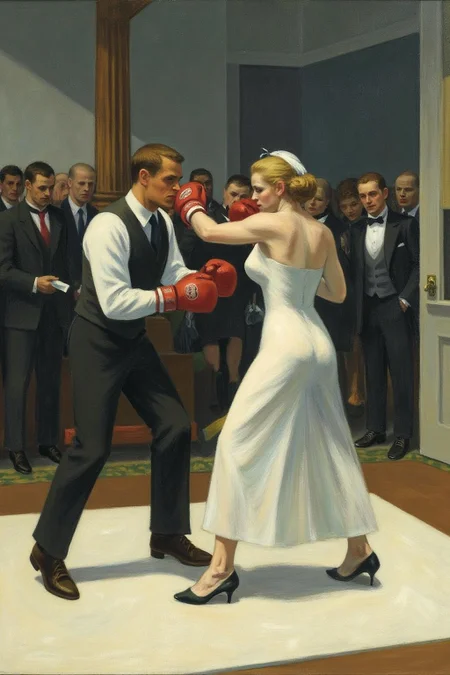
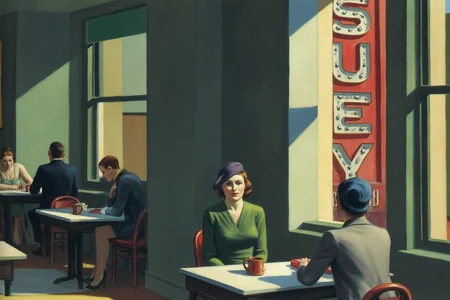
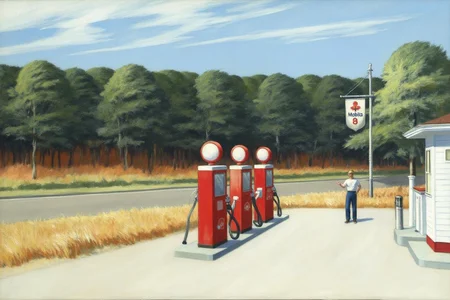
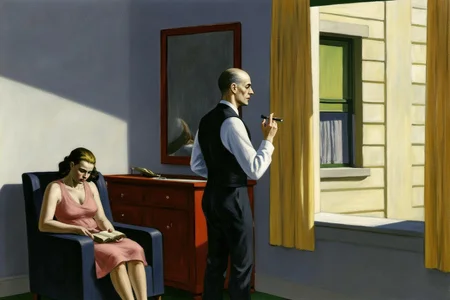
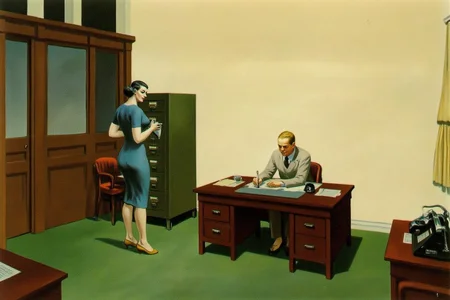
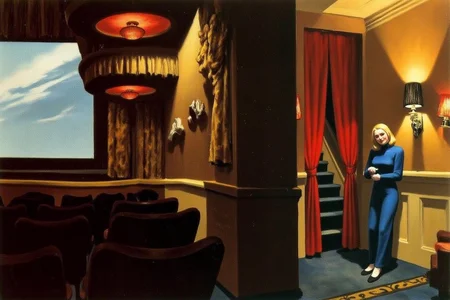
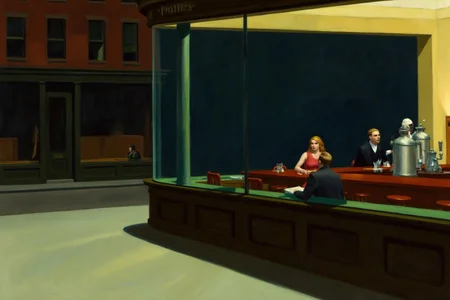
Trained on 46 paintings by the American artist Edward Hopper (July 22, 1882 – May 15, 1967), who was a realism painter and printmaker. To see his works, please go to
From ChatGPT:
.jpg) Hopper in 1937
Hopper in 1937
Edward Hopper (1882–1967) was a profoundly influential American realist painter best known for his evocative, quiet scenes of modern American life, filled with solitude, introspection, and emotional stillness. His work, especially in oil painting and printmaking, captured the tension between people and their environments in the 20th century.
🎨 Signature Style & Themes
1. Loneliness in Modern Life
Hopper’s most iconic paintings often depict isolated figures in urban settings—sitting alone in diners, standing by windows, waiting in empty hotel rooms.
These scenes feel cinematic and meditative, inviting viewers to project their own stories onto them.
2. Light & Architecture
Hopper was a master of light—particularly the interplay between sunlight and shadow. His paintings have a sharp, almost architectural clarity.
He was fascinated by geometric forms, windows, and how man-made spaces framed human experience.
3. Quiet Drama
Despite minimal action, Hopper’s works are filled with emotional tension.
The quietness creates a psychological intensity, like a moment just before or after something significant.
🖼️ Famous Works
Nighthawks (1942) – A moody diner scene at night; arguably his most iconic painting.

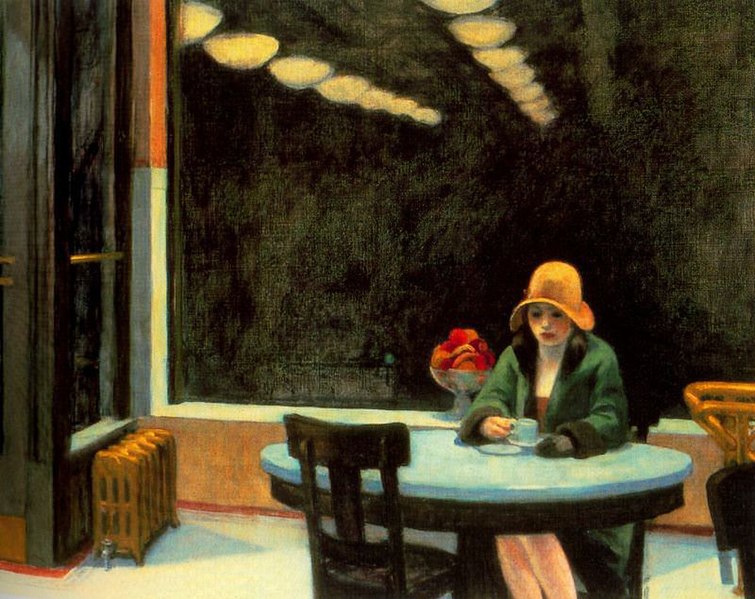
Automat (1927) – A woman alone in a café, surrounded by the reflection of dark windows.
Early Sunday Morning (1930) – A sunlit row of storefronts, utterly devoid of people.

Chop Suey (1929) – Two women in a restaurant, bathed in bright but isolating light.

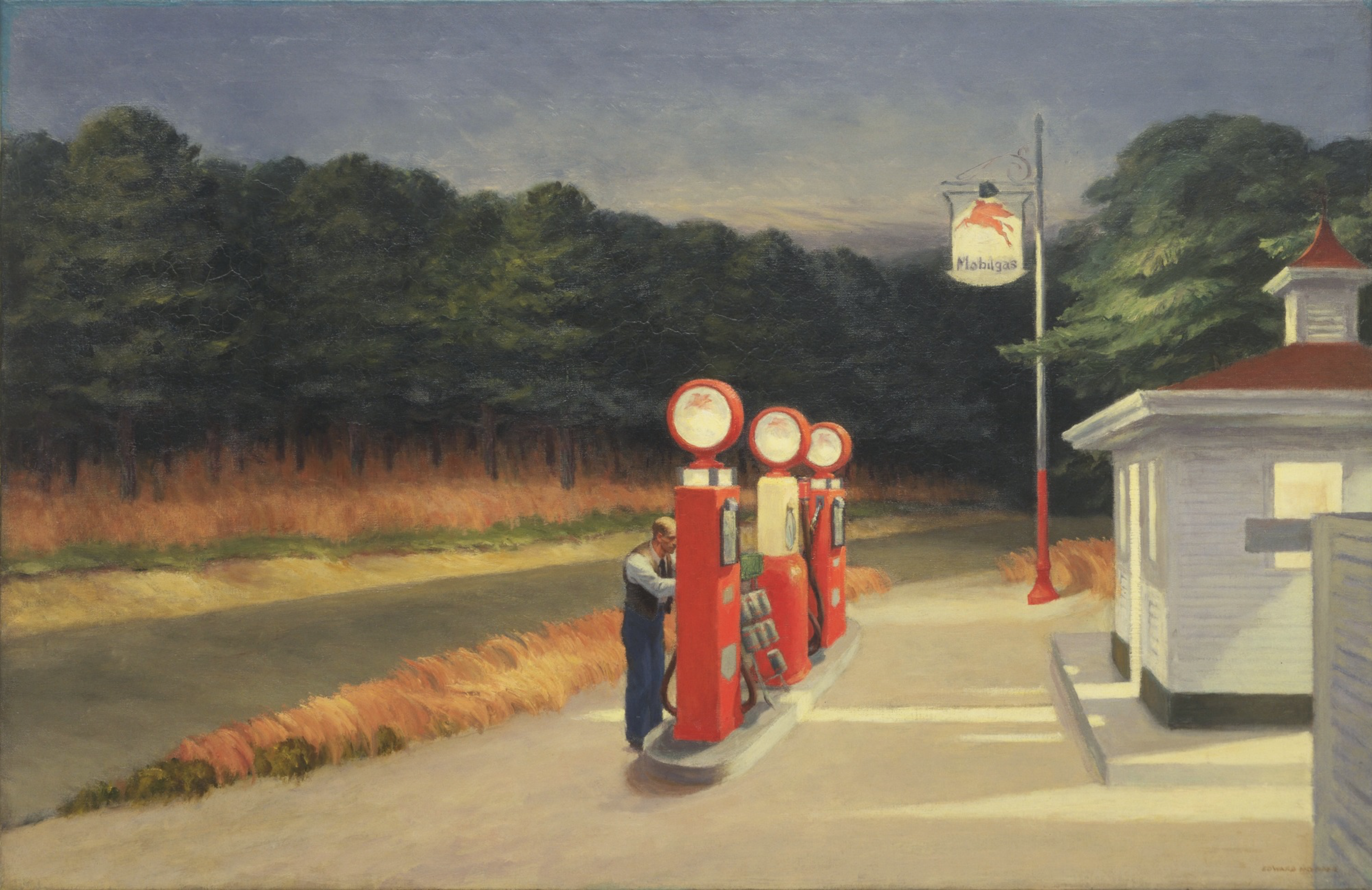
Gas (1940) – A gas station in twilight, quiet and haunting in its stillness.


🧠 Philosophy & Perspective
Hopper once said, “Great art is the outward expression of an inner life in the artist.”
He was deeply introspective, and his work resists flashy spectacle in favor of subtle emotion and psychological depth.
Hopper was influenced by Impressionism (especially Manet and Degas), but stripped it down to bare essentials, favoring mood over decorative flourish.
👫 Hopper & His Wife, Josephine
His wife Josephine Nivison Hopper, also an artist, played a major role in his career.
She was his lifelong model, muse, and fierce advocate, keeping detailed records of his work and life.
🎬 Influence on Film & Pop Culture
Edward Hopper’s visual storytelling had a profound influence on:
Alfred Hitchcock, particularly in Psycho (the house resembles "House by the Railroad")
Film noir lighting and staging
David Lynch, Wim Wenders, Terrence Malick, and more
Even artists like Banksy and writers like Raymond Carver reflect Hopper-esque isolation.
🏛️ Legacy
Hopper gave visual shape to the alienation and quiet poetry of 20th-century American life.
His influence continues in painting, photography, cinema, and contemporary realism—anywhere silence and stillness carry emotional weight.
Would you like a visual breakdown of one of his works or a comparison with another realist like Andrew Wyeth or Charles Sheeler?
Here’s how Edward Hopper compares to other key artists, especially in terms of mood, technique, and themes:
🎨 Edward Hopper vs. Andrew Wyeth
Mood:
Both artists depict quiet, solitary moments, but where Hopper is urban and psychological, Wyeth is rural and introspective.
Wyeth's work leans more into nostalgia and emotional intimacy, like in Christina’s World. Hopper feels more detached, modern, and observational.
Technique:
Hopper: Bold shapes, strong contrasts of light and shadow, simplified forms.
Wyeth: Highly detailed, almost photographic tempera technique.
Themes:
Hopper: Isolation in modern cities.
Wyeth: Loneliness tied to nature, memory, and place.
🖼 Hopper vs. Giorgio de Chirico
Mood & Atmosphere:
Both created eerily still scenes with strong architectural elements and long shadows.
De Chirico’s works, however, are more surreal, with classical references and dreamlike dislocation. Hopper is grounded in reality—no surrealism, just emotional resonance.
Perspective:
De Chirico distorts perspective to disorient; Hopper uses it to emphasize space and silence.
📷 Hopper vs. Walker Evans (Photographer)
Approach:
Both focused on American life during the Great Depression and beyond, capturing similar themes: loneliness, anonymity, small-town stillness.
Hopper painted what Evans photographed—timeless Americana, stripped of sentimentality.
Mediums:
Hopper was a painter, constructing scenes.
Evans captured them as they were, but the emotional tone aligns almost perfectly.
🖌 Hopper vs. David Hockney
Contrast in Color & Tone:
Hopper: Muted, solemn, full of shadow.
Hockney: Vivid, sunlit, and playful, especially his California pool scenes.
Both are fascinated by architecture and space, but Hockney explores joy and abstraction, while Hopper leans into solitude and psychological weight.
🎥 Hopper vs. Film Directors (Hitchcock, Lynch, Wenders)
Visual Storytelling:
Hopper’s compositions are cinematic, often described as “still frames from an unseen film.”
Hitchcock used this in Rear Window and Psycho (motels, quiet buildings).
Lynch channels Hopper in Blue Velvet—cheerful surfaces hiding darker currents.
🧩 Summary Comparison Table:
Artist Shared Traits Key Differences
Andrew Wyeth Solitude, realism, muted tones Hopper = urban; Wyeth = rural
Giorgio de Chirico Stillness, architecture, shadows Hopper = realist; De Chirico = surreal
Walker Evans American life, isolation Hopper = painter; Evans = photographer
David Hockney Architecture, flat color Hopper = somber; Hockney = vibrant
Alfred Hitchcock Mood, suspenseful visuals Hopper = painter of silence; Hitchcock = master of tension
Would you like a visual side-by-side or a focused comparison between Hopper and just one of these artists?
Description
This is epoch 11. Other epochs can be downloaded from tensor.art/models/847309374604131146/Edward-Hopper-P1-1024CpD8Cos5-2025-03-30-20:27:19-Ep-11
FLUX.1 - dev-fp8
Trigger: edwardhopper1 painting
Repeat: 20 Epoch: 2 (Trained on 46 512x512 images for 1840 total steps)
Then trained for another 9 epochs for 10120 total steps
Unet LR: 0.0005 Scheduler: cosine Optimizer: AdamW
Network Dim: 8 Alpha: 4
Epoch Loss
1 0.345
2 0.346<
3 0.334
4 0.333
Prompt: edwardhopper1 painting of a blonde woman dressed as Supergirl, sitting in a cafe with a large window. She is smoking. There is a collie sitting beside her.
5 0.334
6 0.331
7 0.330
8 0.327
Prompt: edwardhopper1 painting of a woman dressed as Catwoman, sitting on a porch. She is smoking. There is a pather sitting beside her.
9 0.336
Aborted by tensor after 1 epoch, so continue training from it
10 0.325
11 0.315<- lowest
FAQ
Comments (1)
Perfect! Love Hopper style and some of the generated pictures looks exactly like his!