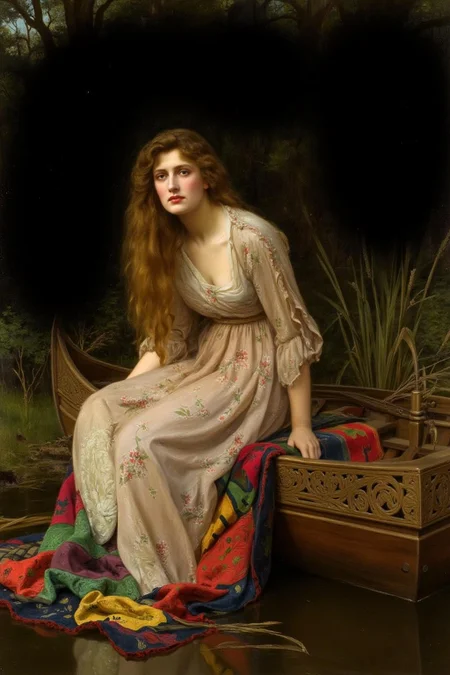
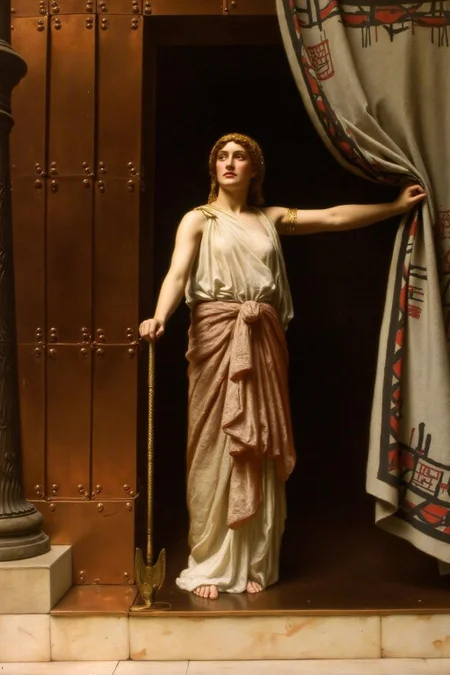


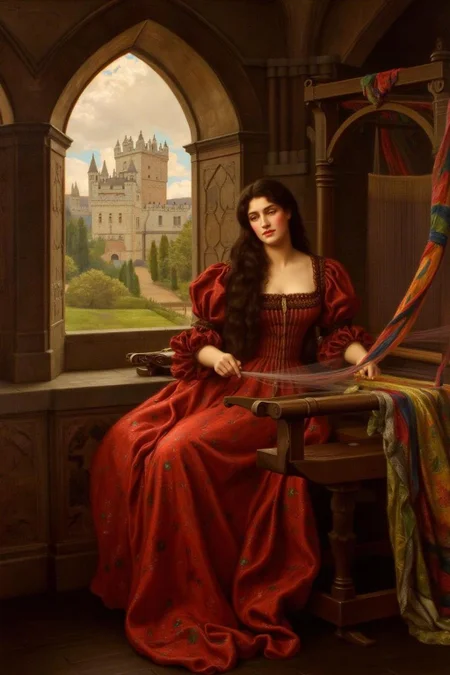
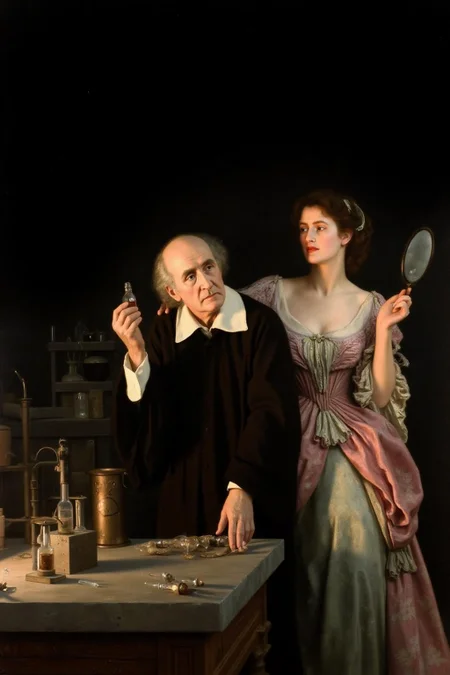

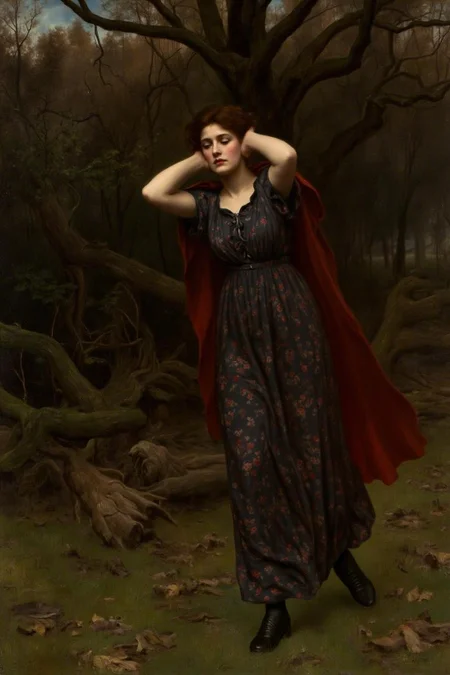

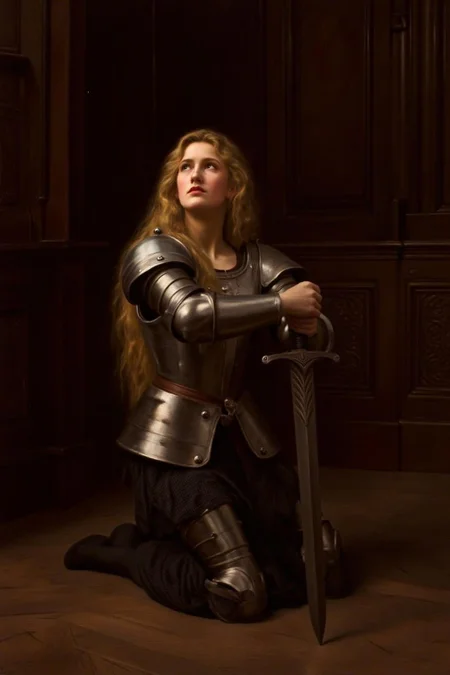
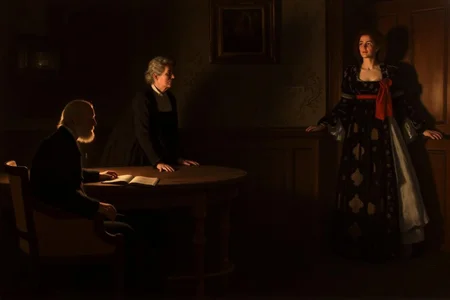
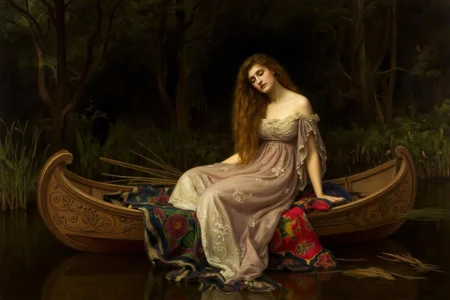
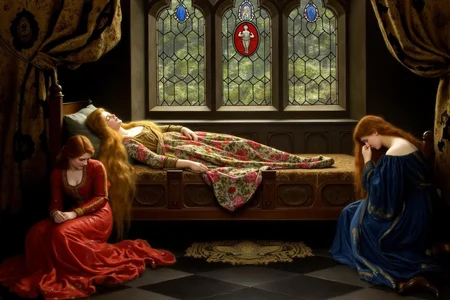



Trained on 32 oil paintings by the British artist John Maler Collier OBE ROI RP (/ˈkɒliər/; 27 January 1850 – 11 April 1934), most of which are based on biblical, mythological or medieval themes. The dataset does NOT include his many portrait paintings, so I'll probably make a portrait style LoRA based on those. Collier was a painter and writer, who painted in the Pre-Raphaelite style, and was one of the most prominent portrait painters of his generation. To see his works, please go to
From ChatGPT:
 John Collier by his first wife Marian, née Huxley, 1882
John Maler Collier (27 January 1850 – 11 April 1934), was a British painter and writer, widely regarded as one of the most accomplished portraitists of the late Victorian and Edwardian periods. Though often grouped with the Pre-Raphaelites, Collier’s work bridges academic realism, mythological allegory, and psychological portraiture, making him a unique figure in British art history.
🎨 Artistic Style & Themes
🖋️ 1. Academic Realism with Symbolic Overtones
Collier was trained at the Slade School of Art and in Paris under Jean-Paul Laurens, grounding his work in strong academic technique.
His style is precise, highly detailed, and classically composed, but often imbued with emotional subtlety.
🌿 2. Pre-Raphaelite Influence
He was stylistically influenced by the Pre-Raphaelites, particularly John Everett Millais and Edward Burne-Jones.
His works often feature mythological, historical, and literary subjects, painted with glowing color, deep symbolism, and luminous detail.
His approach to women, in particular, mirrors the Pre-Raphaelite ideal—elegant, mysterious, and often powerful.
🖼️ Notable Works
Some of his best-known paintings include:
🔹 Lady Godiva (1898)
A dramatic, idealized vision of the medieval legend, with a nude Godiva riding through Coventry.
Blends romantic sensuality with Victorian propriety—a hallmark of Collier's style.


🔹 Lilith (1887)
Inspired by the mythological first wife of Adam, this painting explores feminine power and seduction.
Like other Pre-Raphaelites, Collier often used myth to explore psychological and social ideas.


🔹 Priestess of Delphi (1891)
A striking representation of ancient mystery and divine inspiration.
Exemplifies his interest in classical antiquity, painted with rich fabrics and intense gaze.


🔹Clytemnestra (1882)
The wife of Agamemnon who murders him upon his return from Troy.
Collier’s rendering shows her in the aftermath: powerful, guilt-shadowed, and emotionally complex.
A rare depiction of a female avenger painted with psychological realism.


👥 Portraiture
Collier was a leading portraitist of his day, painting members of British aristocracy, politicians, and scientists.
Subjects included:
Charles Darwin
Thomas Henry Huxley (his father-in-law)
King George V
His portraits are admired for their psychological insight and painterly finesse—serious but never stiff.
📚 Writing and Thought
Collier was also a progressive thinker and author. He wrote:
The Art of Portrait Painting (1905)
A Manual of Oil Painting (1886)
These books helped codify academic art training and were widely used by students.
🧬 Personal Life
He married Marian Huxley, daughter of famed scientist Thomas Huxley.
After Marian’s death, he controversially married her sister, Ethel, which was illegal under British law at the time and required the couple to live abroad.
This personal history, along with his connection to rationalist and scientific thinkers, gave his art a distinct intellectual edge.
🏛️ Legacy
Though not as famous today as some of his peers, Collier’s work is being rediscovered for its:
Technical mastery
Nuanced treatment of myth and morality
Fascinating place between Pre-Raphaelitism and Edwardian classicism
Would you like a breakdown of his mythological subjects or a comparison between him and other Pre-Raphaelite-inspired artists like Waterhouse or Leighton?
Collier’s Mythological Subjects: Symbolism and Substance
Collier’s mythological and literary figures weren’t just decorative—they often reflected psychological tension, feminine agency, or philosophical allegory. Here's a look at some iconic themes:
🔹 Lilith (1887)
Represents feminine autonomy and sensuality.
In mythology, Lilith refuses to submit to Adam and becomes a figure of rebellion.
Collier paints her with intelligence, allure, and menace, inviting the viewer to wrestle with power and temptation.
🔹 Lady Godiva (1898)
The tale of a noblewoman who rides naked to protest taxes on her people.
Collier’s version is elegant and dignified, not overtly erotic, stressing sacrifice, honor, and quiet resistance.
🔹 Clytemnestra (1882)
The wife of Agamemnon who murders him upon his return from Troy.
Collier’s rendering shows her in the aftermath: powerful, guilt-shadowed, and emotionally complex.
A rare depiction of a female avenger painted with psychological realism.
🔹 Priestess of Delphi (1891)
Not a named mythological figure but evocative of ancient prophecy and divine inspiration.
Draped in luxurious fabric with intense expression, she becomes an archetype of female wisdom.
✨ Common Threads
Strong, cerebral women—often misunderstood or vilified in myth—are given presence, depth, and respect.
Collier’s myth paintings reflect a Victorian fascination with classical themes, but also critique gender roles and moral expectations.
Comparison with Pre-Raphaelite-Inspired Artists
Artist
John Maler CollierJohn
William Waterhouse
Frederic LeightonEdward
Burne-Jones
Style
Academic realism with symbolic content
Romantic, dreamy, painterly
Classical perfection, polished academicism
Stylized, otherworldly, tapestry-like
Palette
Earth tones, jewel highlights, balanced compositions
Rich, vibrant, naturalistic lighting
Smooth gradients, idealized color
Muted tones, ethereal palette
Figures
Introspective, dignified, often solitary
Emotional, mystical, often passive or tragic
Idealized, statuesque, mythic
Elongated, dreamy, abstracted
Themes
Myth, literature, feminism, morality
Myth, Arthurian legend, poetic tragedy
Classical myth, allegory, beauty
Arthurian romance, fantasy, medieval themes
Female Representation
Powerful, intelligent, emotionally complex
Romanticized, sensual, wistful
Elevated, idealized, distant
Symbolic, stylized, allegorical
Philosophical Tone
Rational, psychological, modern
Emotional, mystical
Uplifting, idealistic
Dreamlike, melancholic
🧵 In Summary:
While Waterhouse bathes his myths in lush sensuality, Leighton idealizes them in classical serenity, and Burne-Jones dreams them into medieval fantasy, Collier confronts them directly—with moral tension, intellect, and realism.
Collier’s mythological women aren’t ornaments or muses—they’re agents, often standing at the crossroads of history, psychology, and rebellion.
Description
This is epoch 13. Other epochs can be downloaded from tensor.art/models/850591834496313238/John-M.-Collier-1-1024CpD8Co5-2025-04-07-22:37:26-Ep-12
FLUX.1 - dev-fp8
Trigger: johncollier1 painting
Repeat: 20 Epoch: 4 (Trained on 32 1024x1024 images for 2560 total steps)
Then trained for another 8 epochs for 7680 total steps
Unet LR: 0.0005 Scheduler: cosine Optimizer: AdamW
Network Dim: 8 Alpha: 4
Epoch Loss
1 0.373
2 0.358
3 0.365<
4 0.365
Prompt: johncollier1 painting. A man and a blonde woman are seated around a table, engaged in conversation. On the left, a woman in a pink dress, holds her hands together in front of her chest and looks into the distance. On the right, a man, shown in side profile, wears a brown suit with a red tie and holds a pipe. The table is covered with a checkered tablecloth, and a glass of water is in front of the woman. In the background, a burning building with flames and smoke rises.
5 0.359
6 0.356
7 0.351
8 0.364
Prompt: johncollier1 painting. A woman and a black bear sitting in a park for a picnic in a gloomy rainy day.
9 0.353
10 0.359<
11 0.346
12 0.340<-lowest
Prompt: johncollier1 painting.
A redhead woman, shown in side profile, sits on a white horse with a red and gold saddlecloth. She is wearing a white bikini. Stone buildings are in the background.