




Francisco Goya — Paintings & Etchings | Живопись и Графика
LoRA trained on the complete artistic legacy of Francisco José de Goya y Lucientes (1746–1828), spanning his entire creative evolution from luminous Rococo tapestry cartoons to the nightmarish Black Paintings, and from elegant court portraiture to the brutal etchings of Los Desastres de la Guerra. The model captures both his oil painting technique and his graphic work (etching, aquatint, lithography).
Биография / About the Artist
Francisco José de Goya y Lucientes (30 March 1746 – 16 April 1828) was a Spanish Romantic painter and printmaker, widely regarded as the last of the Old Masters and the first of the moderns. His career spanned over sixty years and traversed an extraordinary range of styles, subjects, and emotional registers.
Early Period (1770s–1790s): Goya began as a painter of cheerful Rococo tapestry cartoons for the Royal Tapestry Factory, depicting scenes of Spanish popular life — picnics, dances, games, and festivals — in bright, optimistic palettes.
Court Portraitist (1780s–1800s): He became the leading portraitist of the Spanish aristocracy and royalty, painting the Family of Charles IV, the Duchess of Alba, and numerous nobles with psychological penetration that bordered on satire.
The Turning Point (1792–1793): A severe illness left Goya completely deaf. His art grew darker, more introspective, and increasingly critical of society.
Los Caprichos (1799): A series of 80 aquatint etchings satirizing the superstition, ignorance, and corruption of Spanish society. The famous plate 43, The Sleep of Reason Produces Monsters, became an icon of the Enlightenment's shadow side.
War Works (1810–1820): The Second of May 1808 and The Third of May 1808 paintings, along with the 82-plate etching series Los Desastres de la Guerra, documented the Peninsular War's atrocities with unprecedented raw honesty, stripping war of all heroism.
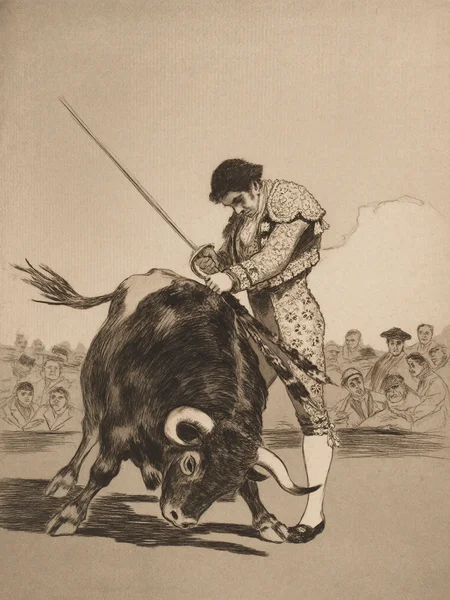
La Tauromaquia (1816): 33 etchings celebrating and documenting the brutality and beauty of Spanish bullfighting.
Los Disparates / The Follies (1815–1824): 22 enigmatic etchings of nightmares, absurdity, and the irrational, pushing graphic art toward surrealism a century before the term existed.
The Black Paintings (1819–1823): In his final years, Goya painted 14 murals directly onto the walls of his farmhouse, the Quinta del Sordo. Works like Saturn Devouring His Son, Witches' Sabbath, and The Dog are among the most disturbing and psychologically intense images in Western art.
Bordeaux Period (1824–1828): Exiled in France, Goya produced some of his most luminous and proto-Impressionist works, including The Milkmaid of Bordeaux, before his death at age 82.