🚀 Run It on RunningHub
🎁 New users on RunningHub International can get 1000 RH Coins after registration.
NEW Workflow name: BUNNY_SelfLift_12GB Direct 1080P_High Motion + LoRA Sharp_Hybrid Workflow
工作流名称:BUNNY_SelfLift_12GB直出1080P_高动态+LORA不模糊_混合工作流
Tested hardware: RTX 4070 Ti 12GB VRAM.
实测硬件:RTX 4070 Ti 12GB 显存。
A 10-second H3 video at around 1080P / 2.0MP takes approximately 15 minutes locally on 12GB VRAM.
10秒 H3 视频在约1080P / 2.0MP下,本地12GB显存实测生成时间约 15分钟。
The same 10-second test takes approximately 7 minutes on RunningHub.
同样的10秒测试,在 RunningHub 上大约 7分钟完成
🎬 BUNNY H3 High-Dynamic Two-Pass Latent Upscale Workflow
▶ Start / End Frame One-Click Workflow
▶ Multi-Reference One-Click Workflow
📦Bunny Official RunningHub Model Page
Future FourBunny LoRAs will also be released and updated on RunningHub.
Highly recommended for complex action: pair this LoRA with BUNNY H3 Conditioning Bridge for better multi-character logic, action ownership, and scene stability.
复杂动作场景强烈推荐搭配 BUNNY H3 Conditioning Bridge,可进一步改善多人互动逻辑、动作归属和场景稳定性。
Combat Base V2 is a major upgrade over V1, focusing not only on faster combat, but on better action continuity, hit reactions, cumulative damage, spatial movement, and physical cause-and-effect.
Combat Base V2 is no longer just a combat LoRA — it now works for both action and dialogue scenes, adding richer body movement, finer sound details, and stronger shot-to-shot continuity to character performance.
Combat Base V2 不再只是一个武打 LoRA——它现在可文可武,在文戏中也能增加更丰富的身体动作、更细致的声音表现,以及更强的镜头与状态连续性。
【MiniMax H3】12GB VRAM|Universal FL2VA/REF2VA Base Model + Low-Sigma Combat Second-Pass Workflow
Core Physics & Motion Logic / 核心物理与动作逻辑
Combat Base V2 moves away from "attack → reset" loops into a continuous physical chain where missed strikes carry momentum, blocks change direction smoothly, and limbs separate cleanly without sticking.
Combat Base V2 摆脱了“攻击 → 复位”的回合制循环,形成持续的运动链,招式落空可延续动量,格挡可自然顺势变向,且接触点脱离干净不黏连。
Hit reactions now persist and accumulate—sustained torso bending, lowered guards, and impaired mobility directly build toward convincing heavy finishers.
受击状态具备持续性与累计效应,躯干弯曲、护架变慢及移动受限等伤害会自然保留,让最后的重击终结更加合理成立。
Combat Skillset & Staging / 动作技法与镜头调度
Upgrades include continuous rotational kicks, sustained grappling and takedowns, dynamic 3-stage environmental collisions, and multi-phase fall trajectories.
全面升级连续旋转腿法、持续近身缠抱摔投、三阶段环境碰撞(人体→环境→材质),以及拥有完整轨迹的特技跌落表现。
Supports cinematic 1vMany choreography via staggered attacker entrances, spatial lane control, continuous protagonist-centered tracking, and motivated cross-cut motion continuity.
支持电影级“一对多”围攻调度,利用交替切入、环境通道压迫、主角中心跟随镜头以及跨镜动作连贯性提升画面表现。
Dialogue Performance & Benchmarks / 文戏表现与测试数据
Internal same-seed dialogue tests revealed +19.5% in-shot motion, +34.2% audio RMS, and +22.4% edge sharpness, significantly enhancing physical acting, breathing, and vocal dynamics outside of fight scenes.
同 Seed 文戏测试显示镜内动作量增加 +19.5%、Audio RMS 提升 +34.2%、边缘锐度提升 +22.4%,大幅增强了武戏之外的肢体表演、呼吸与声音动态。
Workflow & Trigger Usage / 工作流与触发词使用
For optimal flow, structure prompt timing as ACTION → DIALOGUE; start with No Trigger for maximum anatomical accuracy, add
prfight2for higher intensity, orprfight2, prfin1for heavy stunt impact.建议将提示词结构设为“动作 → 对白”;优先使用 No Trigger 换取最稳动作与人体,需要强攻击性时加入
prfight2,重终结/特技受击则使用prfight2, prfin1。Includes two specialized combat-director workflows (General & 1vMany) with Chinese instructions that support prompt output in any target language.
附带“通用”与“一对多”两个专用武戏导演工作流,内置中文说明并支持生成任意语言的最终 Prompt。
Direct the fight first. Write the prompt second. 先把战斗导演好,再去写提示词。
Upgrade Notes:
测试发现:同一镜头包含打斗和台词时,必须先完整完成击打动作再说台词,否则容易退回底模的慢动作表现。
Test finding: When combat and dialogue are in the same shot, complete the attack before the dialogue, or the motion may revert to the base model’s slower behavior.
About This LoRA|关于这个 LoRA
先说明一下:这不是一个魔法 LoRA,也不会自动帮你编排完整的武打动作。
First of all: this is not a magic LoRA, and it will not automatically choreograph a complete fight for you.
如果你只写 two people fighting、a woman fights a man 之类非常简单的 Prompt,模型很可能只是让两个人高速乱挥拳,最后变成一段很快但没有逻辑的“王八拳”。
You still need to tell the model who attacks first, what they do, where the strike lands, how the opponent dodges or reacts, and why the next attack can naturally follow.
Prompt 负责决定“他们怎么打”,LoRA 负责增强“这些动作怎么表现”。
The prompt decides what the fighters do, while the LoRA enhances how those actions are performed.
这个 Combat LoRA 前后训练和测试了好几个版本,也尝试过不同的数据比例、战斗速度、受击反应以及终结动作训练方向。
This Combat LoRA went through several training and testing versions with different dataset balances, combat-speed behavior, hit reactions, and finisher-focused training.
有些旧版本确实能让战斗明显变快,但高权重下也容易破坏 H3 本身不错的动作流畅度,让视频出现倍速感、模糊或者没有恢复过程的连续乱打。
Some earlier versions could make fights noticeably faster, but at higher weights they could also damage H3's native fluidity and produce sped-up motion, blur, or endless attacks without proper recovery.
目前发布的这一版,是我实际测试下来相对最平衡、也比较好用的一版。
The version released here is currently one of the most balanced and practical versions from my testing.
它不再单纯追求“打得更快”,而是重点强化 连续战斗、命中反馈、身体失衡、后仰、踉跄、击倒、终结逻辑以及攻击产生的实际结果。
Instead of simply making fights faster, it focuses more on continuous combat, impact reactions, loss of balance, recoil, staggering, knockdowns, finishing logic, and clearer physical consequences after attacks.
我的目标是尽量保留 H3 本身已经不错的动作连续性,同时让每一次有效攻击看起来更有重量、更有反馈,也更有“打中了以后真的发生了什么”的感觉。
The goal is to preserve H3's existing motion continuity while making successful attacks feel heavier, more reactive, and more consequential.
Trigger Words|触发词
prfight1 — General Combat|普通战斗
普通战斗只需要使用 prfight1。
For normal combat scenes, simply use prfight1.
prfight1, prfin1 — Finisher / Knockout|终结 / 击倒
当这一段战斗需要一个明确的终结、KO、击倒或决定性收尾时,在 prfight1 后加入 prfin1。
When the fight needs a clear finisher, knockout, takedown, or decisive ending, add prfin1 after prfight1.
prfight1, prfin1, prslow1 — Slow-Motion Finisher|慢镜终结
需要在最后一击加入短暂的慢动作强调时,再加入 prslow1。
Add prslow1 when you want a brief slow-motion emphasis on the decisive finishing strike.
注意:只加入 prslow1 并不代表模型一定会自动产生慢动作。
Important: simply adding prslow1 does not guarantee that slow motion will automatically appear.
你还需要在 Prompt 里明确告诉模型:最后一击在命中瞬间进入短暂慢动作,然后恢复正常速度。
You also need to explicitly tell the model that the decisive final strike receives a brief slow-motion emphasis at the moment of impact, then normal speed resumes.
An Easy Way to Write Better H3 Fight Prompts|最简单的高质量提示词写法
如果你不想自己手动写复杂的动作编排,一个非常简单的方法是直接使用 MiniMax H3 官方的两个 Prompt Writing Guide 文件。
If you do not want to manually write complex choreography, an easy method is to use the two official MiniMax H3 Prompt Writing Guide files.
把这两个官方提示词模板文件一起上传给 Gemini。
Upload both official prompt-writing guide files to Gemini.
然后告诉 Gemini:按照这两个官方文件的规则,用六段式结构为 H3 编写视频提示词,并告诉它视频长度、剧情和你想要的战斗内容。
Then tell Gemini: follow the rules from these two official files and write an H3 video prompt using a six-part structure, while specifying the video duration, story, and desired fight choreography.
通常你只需要告诉 Gemini:几秒、什么剧情、谁打谁、最后想怎么结束,它就可以按照官方模板帮你扩展成一段完整得多的 H3 武打提示词。
Usually, you only need to tell Gemini the duration, basic story, who fights whom, and how you want the sequence to end, and it can expand that into a much more complete H3 fight prompt using the official structure.
这也是我目前比较推荐的使用方式:不要让模型自己猜怎么打,而是先让 Gemini 帮你完成动作编排,再把结果交给 H3 + Combat LoRA。
This is also my recommended workflow: do not make the video model guess the choreography; let Gemini build the action sequence first, then send the resulting prompt to H3 + Combat LoRA.
Compatibility|兼容性说明
目前我只在 MiniMax H3 FL2VA 上完整测试过这个 LoRA。
At the moment, I have only fully tested this LoRA with MiniMax H3 FL2VA.
其他 H3 模型、不同生成模式或其他工作流我暂时没有进行系统性测试。
I have not systematically tested it with other H3 variants, generation modes, or workflows.
所以在非 FL2VA 环境中能否获得相同的效果,我目前无法保证。
Therefore, I cannot currently guarantee identical behavior outside the FL2VA setup.
Description
FAQ
Comments (56)
looks mind blowing, will test
man of culture, i see
This looks amazing. AI is now producing better fight animation than some video games!
I get what you're trying to say, however...
You comparison isn't valid.
This is a static animation with a predetermined set of images that do not deal with environmental influences such as artificial gravity, friction, impact forces, and so on. It never changes what it is, it'll be the same animation every time you play it back. It's simply a series of drawing on a 2d plane without any 3d geometry being rendered while also needing to interact in real time with objects, characters, and environmental systems.
This is no where near the level of an actual animator who understands how to draw and render characters, it also is using data from humans and regurgitating it as an approximation of the data it has in its database.
When you control a character in a video game you're not controlling a series of images being played back in a video player. You're interacting in a world that's being rendered in real time. AI videos and images aren't anything like a video game engine.
While H3 and this Lora are remarkable for what they can achieved, it's NOTHING like a well crafted cinematic done by SquareEnix or Blizzard and other development houses. It's not even in the same realm as them. If you look frame by frame you'll see a lot of issues that you don't see in animations done by actual people.
All that said, both the Lora and the base model handle fight scene well. I'm actually shocked how good H3 is by itself.
Only, native 20 steps provide the same quality and speed motion than in the preview samples.
Using turbo lora, make the video slow motion. I just made several tests
The demo videos all use Turbo LORA, with 10 steps and a 0.5 scale resolution. A 10-second video takes 3 minutes to generate. Please check your prompt and try adding “real-time speed” or similar instructions, or simply tell the AI not to use slow motion.
@FourBunny The only video that keep the fast motion, is the one genrated with the 10Eros MAx GGUF model.
I use the enw turbo lora 4 step v1 768p and 8 step v1.
Thanks for the params, i will test them immediatly.
Here my prompt, same prompt used for all my tests, and i made like 20 test, at 0.4 resolution, 0.7 resolution, with NVFP4 model and 10Eros model with 4 steps, and with 8 step turbo lora, and without turbo lora :). I'm testing your lora since like 2h now.
Here my prompt the prompt is made by my AI Director included in my H3 normal workflow. I also use my own custom nodes+workflow. no comfyui native node in all my workflow :) :
https://i.postimg.cc/YSfbSgMG/Capture-d-ecran-2026-08-13-033527.png
For the target video, at 0.00 seconds into the target video, <Picture 1> (from [Shot 1]) is fully referenced.
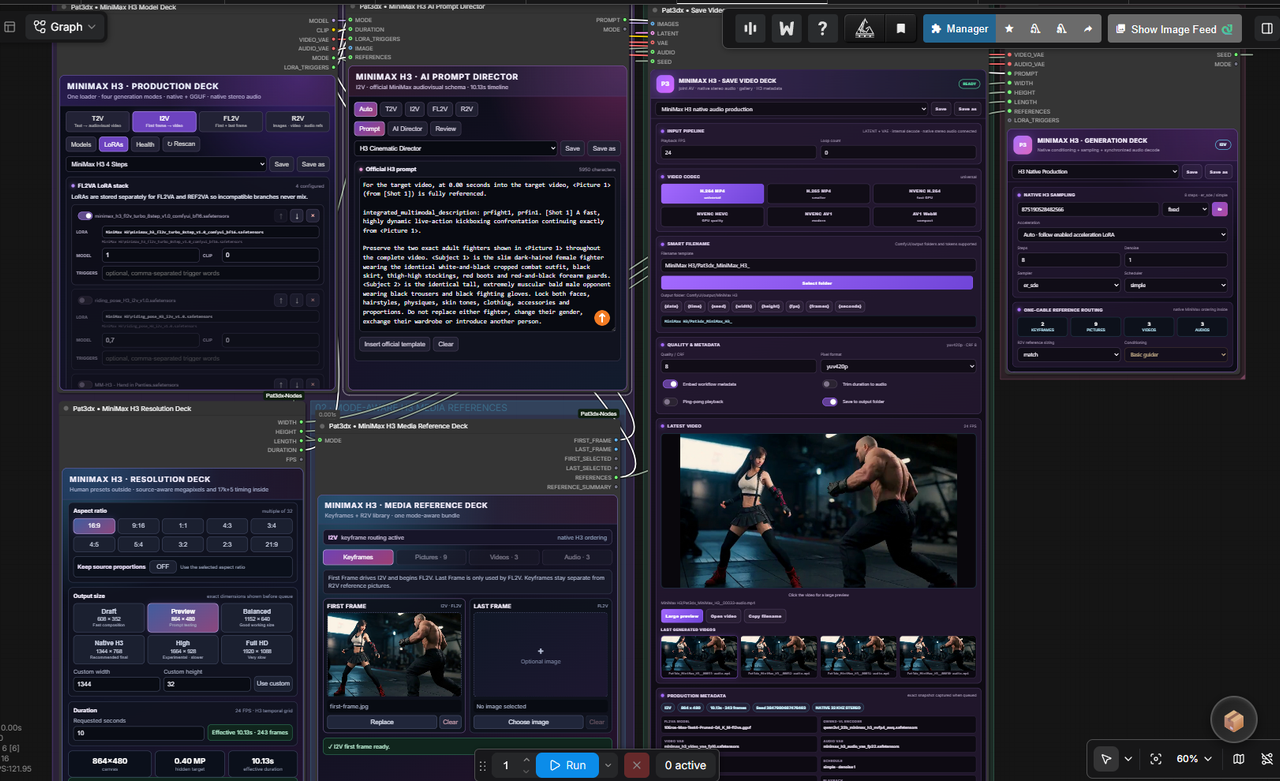
integrated_multimodal_description: prfight1, prfin1. [Shot 1] A fast, highly dynamic live-action kickboxing confrontation continuing exactly from <Picture 1>.
Preserve the two exact adult fighters shown in <Picture 1> throughout the complete video. <Subject 1> is the slim dark-haired female fighter wearing the identical white-and-black cropped combat outfit, black skirt, thigh-high stockings, red boots and red-and-black forearm guards. <Subject 2> is the identical tall, extremely muscular bald male opponent wearing black trousers and black fighting gloves. Lock both faces, hairstyles, physiques, skin tones, clothing, accessories and proportions. Do not replace either fighter, change their gender, exchange their wardrobe or introduce another person.
The fight takes place inside the same industrial combat gym shown in <Picture 1>. Preserve the dark training floor, concrete walls, gym equipment, overhead strip lighting and cinematic shallow-depth background. Both fighters begin in the exact positions and fighting stances visible in the supplied opening frame.
Fast real-time competitive fighting pace. Explosive athletic acceleration between positions, compact recovery after every strike and immediate causal counters. Each block, dodge and contact remains individually readable despite the rapid cadence. No cinematic slow motion, no prolonged anticipation, no extended posing and no artificial fast-forward effect.
At the opening, <Subject 2> attacks first. He explosively steps forward and throws one long right straight punch toward <Subject 1>'s face. <Subject 1> instantly slips outside to her left while sharply parrying his wrist across her body with her right forearm. His punch misses beside her head and his forward momentum briefly exposes the center of his torso.
<Subject 1> immediately counters with a fast left jab that lands against <Subject 2>'s raised right glove, forcing his guard inward. Without stopping, she plants her lead foot, rotates her hips and drives one compact right cross into the center of his upper chest. The impact visibly compresses his torso, throws his shoulders backward and forces him to take one rapid recovery step toward the concrete wall.
<Subject 2> regains his footing and retaliates immediately with one powerful left hook aimed at <Subject 1>'s head. She ducks cleanly beneath the hook while moving forward, his glove sweeping just above her dark hair. From the lowered position she drives one short right body hook into his exposed left ribs. The strike lands with visible glove compression; his torso folds sideways, his left elbow drops and his balance breaks.
Using that opening, <Subject 1> rises explosively into a left hook that lands against the side of his upper guard. His head and shoulders recoil together and he staggers backward until his shoulder meets the concrete wall. He remains conscious and attempts to raise both gloves, but his stance is unstable and his knees are slightly bent.
<Subject 1> maintains pressure with fast, precise footwork. She delivers one sharp left jab into his gloves, immediately followed by a straight right punch that drives his guard against his face. Each contact produces a separate readable impact and recoil. He slides sideways along the wall, struggling to maintain his footing.
For the decisive finish, <Subject 2> attempts one desperate wide right hook. <Subject 1> slips underneath it, pivots rapidly on her supporting foot and delivers one explosive left roundhouse kick into his crossed upper guard. Her shin contacts both forearms with a single heavy, unmistakable impact. His gloves compress against his face, his upper body snaps backward against the wall and his feet slide forward across the floor.
Normal real-time speed continues after the final impact. <Subject 2> rebounds from the wall, staggers two uneven steps, loses his balance and drops heavily onto one knee while catching himself with one gloved hand. <Subject 1> immediately stops attacking, takes one fast step backward and returns to a disciplined fighting guard. She remains standing and alert while <Subject 2> stays visibly defeated on one knee, completing a clear and decisive knockdown.
Every movement follows a causal sequence: attack, defense, opening, counterattack, contact and immediate physical consequence. Strikes carry believable weight and directional momentum. Feet remain planted during impact; hips and shoulders rotate anatomically; guards react correctly; recoil travels naturally through the opponent's head, torso, legs and balance.
No random windmill punching, no ineffective air punching, no simultaneous unrelated attacks, no repeated looping actions, no teleporting, no body merging, no extra fighters, no duplicated limbs, no changing gloves, no changing wardrobe, no blood and no graphic injury.
Camera: One uninterrupted medium-wide three-quarter ringside shot at eye level. Both fighters' faces, hands, torsos, legs and feet remain visible during the entire fight. The camera tracks laterally at moderate speed with small controlled handheld energy, reacting quickly enough to follow the exchange while maintaining stable spatial geography. Brief natural impact shake only on the strongest body punch and final kick. No cuts, no abrupt reframing, no excessive motion blur and no slow camera drift.
overall_soundscape: Clearly audible synchronized stereo combat audio throughout. Fast shoe pivots and rubber foot slides on the gym floor, sharp leather glove strikes, blocked punches against padded forearms, deep body-impact thuds, one powerful padded kick impact, forceful breathing, short exertion grunts, clothing movement, concrete wall vibration and realistic industrial-gym room reflections. Every impact sound is individually synchronized with visible contact. No silence.
non_diegetic_music: N/A
@FourBunny Ah, i also tested your first frame in the R2V, with NVFP4, and the slow motion is gone with R2V, and i get a fast motion combat video :)
@Pat3dx are you using video shift 6.0 as recommended by Lightx2v team? using the modelsamplingminimaxh3 node? 6.0 for 4-step, 12.0 for 8-step.
@Pat3dx Thanks for the feedback! I don’t think the slow-motion behavior is necessarily caused by the LoRA alone — H3 can sometimes emphasize heavy impacts or finishing moves depending on how the prompt is written.
I’ll send you the six-part prompt structure I normally use. You can give it to GPT/Grok and ask it to rewrite your fight prompt with continuous real-time motion, brief contact, immediate strike recovery, and no impact slow-down. That should make it easier to test whether the issue comes from the prompt or the LoRA.
subject_definitions:
<Subject 1> is the adult woman from <Picture 1>. Her facial identity, hairstyle, body proportions, clothing, and all recognizable visual details must remain consistent with <Picture 1> throughout the entire video.
<Subject 2> is a large rough male thug in dark street clothes, already backed against a worn concrete wall at the beginning of the fight.
summary: [reference generation + combat showcase] A 10-second high-impact wall beatdown designed specifically to showcase prfight1. <Subject 1> relentlessly pressures <Subject 2> against a wall through escalating body punches, head strikes, elbows, knees, and one decisive finishing blow. The action prioritizes clear strike trajectories, momentary contact, immediate separation, interrupted recovery, cumulative hit reactions, and synchronized impact audio. <Subject 2> never takes control of the exchange and never launches a clean counterattack.
retention_analysis: <Subject 1> (appears throughout): fully_preserved - identity, hair, clothing, proportions, and recognizable details remain locked to <Picture 1>.
<Subject 2> (appears throughout): consistently portrayed as the same large male thug; he remains trapped near the wall until the final knockdown.
<Picture 1>: identity reference for <Subject 1>; preserve her appearance throughout all shots.
detailed_description: The target video is a 10-second real-time combat showcase using trajectory-first choreography. prfight1 provides the speed and strike density; the choreography emphasizes readable attack paths, clear separation after contact, escalating hit reactions, recovery interruption, and heavy environmental feedback. No slow motion.
[Shot 1] 00:00.000–00:01.800. The sequence opens in a medium-wide three-quarter view with <Subject 2> already backed against a rough concrete wall and <Subject 1> directly in front of him at punching distance. The camera gives a short controlled push toward them. <Subject 1> steps into range and snaps a left jab across his mouth; her fist touches only for an instant and immediately recoils. His face turns slightly but his stance remains intact. Before his head fully returns, she shifts her weight forward and sends a right cross across his jaw. Her fist sweeps through the impact line and clears his face immediately. His head recoils harder, his shoulders strike the wall behind him, and his knees flex to absorb the impact. She stays directly inside his recovery space. He does not attack; he is occupied with protecting himself and regaining balance.
[Shot 2] At 00:01.800, cut into a tighter lateral tracking medium shot while preserving the same positions. <Subject 2> is still rebounding from the wall. <Subject 1> drops her level and sweeps a compact left hook across his ribs. The fist clears immediately after contact; his torso compresses toward the struck side and his elbow drops. That opening exposes his center. She steps closer and drives a right knee briefly into his abdomen, retracting it immediately as his body folds forward independently. Before he can straighten, she catches his shoulder with her left hand only to control distance and whips a short right elbow across his cheek. The elbow continues past the contact line as her torso rotates. His head jerks sideways and the wall catches his upper back again. The camera tracks only a few inches with the movement, keeping every strike readable.
[Shot 3] At 00:03.700, cut to a slightly lower three-quarter angle, still close enough to read both bodies from the knees upward. <Subject 2> tries to raise both forearms into a defensive shell but does not throw an attack. <Subject 1> shifts laterally around the edge of his guard and attacks the openings instead of striking blindly into his arms. A short right body hook sweeps beneath his elbow and retracts; his stomach tightens. A left hook travels over the lowered guard and clips across his jaw, immediately clearing the side of his face; his head turns and one shoulder drags across the wall. While he is still trying to square his feet, she drives a straight right into the center of his chest and instantly pulls it back. His upper body slams flat against the wall, his shoes skid forward half a step, and his guard briefly falls apart. Each reaction grows stronger than the previous one, but he remains standing.
[Shot 4] At 00:05.700, the camera makes a controlled side glide as <Subject 1> surges into the opening created by his broken guard. She begins a compact pressure combination without resetting between strikes. A left jab snaps his head upward and immediately returns to guard. While his chin is still lifted, a right cross sweeps across his jaw and clears cleanly, rotating his shoulders against the wall. As he tries to shift one foot sideways to escape, she pivots after him and sweeps a left hook across his ribs, stopping the escape step and folding his torso. Before he can unfold, she rises through a short right uppercut under the chin; the fist passes upward through the impact line and retracts immediately. His head lifts, his shoulders scrape upward against the wall, his legs stagger, and his hands drop lower from accumulated damage. <Subject 1> remains balanced and close, breathing hard but still in complete control.
[Shot 5] At 00:07.800, cut to a dynamic medium shot with a subtle forward push for the climax. <Subject 2> is barely upright against the wall, guard loose, feet badly aligned, chest heaving. He does not attack. <Subject 1> steps through one final compact sequence designed around his accumulated imbalance. She snaps a left jab into his face and immediately retracts it, forcing his head back toward the wall. She follows his recoil with a short right hook across the body, clearing his ribs as his torso folds and his balance shifts onto one leg. Using that collapsed posture, she plants her support foot, turns her hips and shoulders, and whips one decisive left hook across his exposed jaw. Contact is momentary. Her fist sweeps completely past the side of his face and immediately recoils while his body continues reacting independently. His jaw turns first, his head follows, then his shoulders and hips rotate away from the wall. His feet lose their alignment, his body slides sideways off the wall, and he collapses heavily onto the floor. The camera follows his fall only far enough to show the full knockdown, then rises back toward <Subject 1> standing over him in a stable dominant pose, fists lowering as she exhales.
overall_soundscape: No spoken dialogue. Neither character says any intelligible words during the entire video. <Subject 1> produces only short nonverbal exertion sounds synchronized with major strikes: clipped breath bursts, compact effort grunts, and one stronger effort shout on the finishing hook. <Subject 2> produces only nonverbal hit reactions: short muffled grunts on lighter punches, deeper body-shot grunts on hooks and knees, sharper cries on elbows and heavy head strikes, and one final involuntary cry as he collapses. Every successful strike has one distinct synchronized impact sound. Missed or clearing limbs produce brief air movement without false impact sounds. Repeated wall impacts produce heavy body-against-concrete thumps, clothing scrapes against the wall, shoe skids, footwork, fabric movement, increasingly heavy breathing, and a final solid body crash onto the floor. No invented speech or background voices.
non_diegetic_music: N/A
@FourBunny Ok, i switched to the int8 conv model, and it changed everything. Amazing video quality and sound, fast motion, everything is perfect, and i made test with and without your lora, the difference is enourmous.
Really well done.
I also switched back to the Lightx2v 4 step lora i used before i tested the new 4 step 768p v1 and 8 step v1 moras, and this is just perfect.
And i can confirm that the slow motion came from the turbo lora, not model or your lora.
The best turbo lora for your lora, is the lightx2v 4 step at 6 or 10 steps. with int8 conv model.
Even at 4 step it profuce amazing quality, swert spot 6 step, production quality and more dynamic and scenario understanding video at 10 steps.
Thanks for this amazing lora.
It will be very helpful to animate my kickboxing and boxing 3DX comics series :)
@AI_DK yes my workflow automaticaly handle by it own the shift for all lora.
12/3 for the new 8 step lora, and 6/3 for the new 4 step768p v1 lora
@Pat3dx Thank you for testing it.
@FourBunny I just uploaded two of my test videos from my 3DX comics series character. Check them :)
@FourBunny I added a Combat preset in my AI Director :)
It generate T2V or I2V scenarios, and add in the timeline
https://postimg.cc/gallery/L9BVCSD
@Pat3dx nice
@FourBunny I just posted the first T2V fight scene genrated with my workflow and AI Combat director, and your combat lora :)
感谢分享! 辛苦了
Honey, what's a good LoRA strength setting?
Very cool.
nice, waiting for fighting lora
Can I use this Combat LoRA to generate sex scenes? After all, sex is technically a form of combat too.
I don't know about that—why don't you give it a try?
amazing , thanks this is sooo cool
rockx
somebody gotta make a enhanced blood lora to pair with this
无敌了
能分享一下你都工作流吗
厉害了
this lora is also good for creating 1 long shot, like a long cinematic sequence without any cuts especially in scenes where minimax would rather cut than listen to your pormpt
Dear OP, when a character has their hands bound and is suspended mid-air while another character beats them, this Lora performs very poorly. The suspended character behaves like a rigid pillar — they don't sway or get knocked back at all upon impact. The attacker's punching motions end up looking like light tapping, and their hits often whiff completely, striking thin air. On top of that, the audio has a chance to produce loud cracking/popping artifacts.
Thanks for the detailed report. This makes sense — suspended/restrained hit reactions are not well represented in the current training data, so the model can treat the restrained character too rigidly instead of producing swing, rotational recoil, and restraint-tension feedback. I’ll add this to the list for a future version. The cracking/popping audio artifact may be separate from the combat motion behavior, but I’ll keep an eye on it as well.
after the latest comfyui update, this lora seems to break I think. When enabled, it takes generations at 20 steps over an hour for 10 seconds. It used to not do that.
The LoRA itself should still be fine. Recent ComfyUI updates appear to have introduced Dynamic VRAM / LoRA performance regressions on some systems. I’m still using my older environment without this slowdown. Try disabling Dynamic VRAM or rolling back to the commit you were using before the update.
@FourBunny ah that may be it. I will take a look at that.
@FourBunny That was it, works fine with Dynamic VRAM disabled.
还是不太适合高速战斗,人物都变成虚影了
This LoRA works best when used with the author’s workflow. Follow the author’s recommended settings for the parameters — the results are incredibly strong, and it’s quite fast too.
loving it makes fight scenes really cool. But how do you enable those cool looking finisher moves in your showcase ?
I just told the AI to add a finishing move to this video. I didn’t specify how to do it—I let it come up with something on its own, as long as it looked cool.
@FourBunny cool :D time for mortal kombat finishers XD
Nice waiting for update.. please do without trigger words
yesss waiting , this is sooo nice
So impressed with this. It does add a lot of noise to the ouput, but the movement excitement, coherence, and camera angles, it's all WAY good. Given the high action, I value what it does well over the cost of the extra noise. It's so good.