DO NOT USE FOR COMMERCIAL PURPOSES
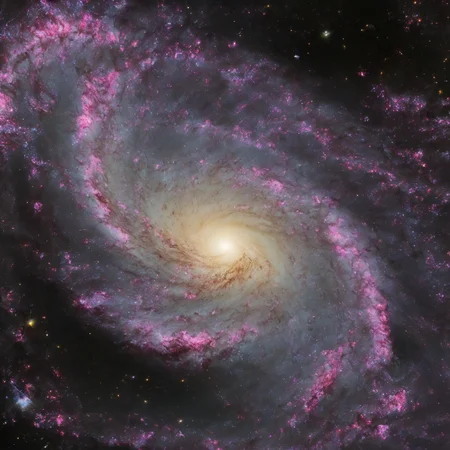
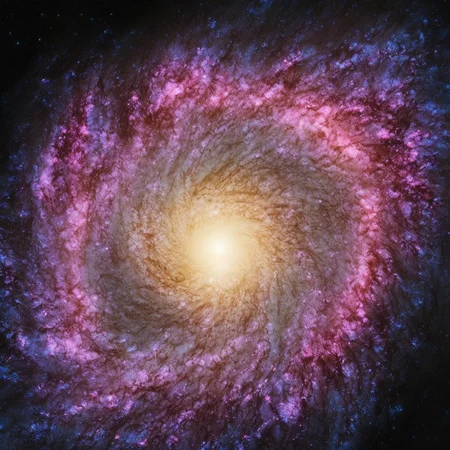
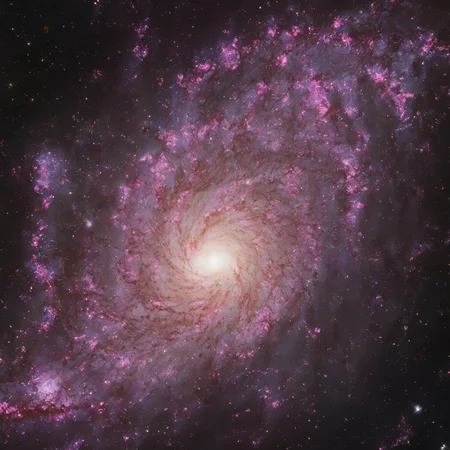
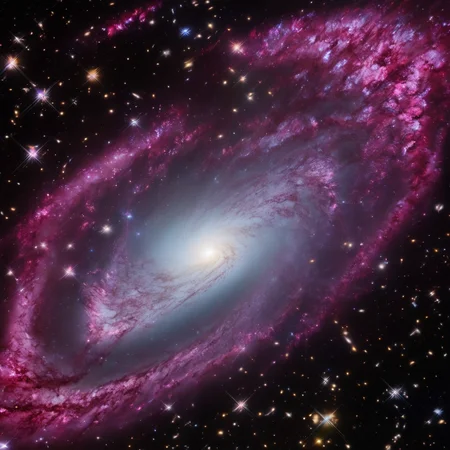
Now you have your own AI Telescope to see through the very darkness of deep space.
This is an SDXL1.0 version Galaxy lora. It was trained with the offical sd_xl_base_1.0. Sizes that my GPU can afford are 960x960, 1024x1024 (before upscale).
Trigger word is Galaxy. Other prompts that you may find in my examples are not necessary, but you can always paint your galaxies with color prompts.
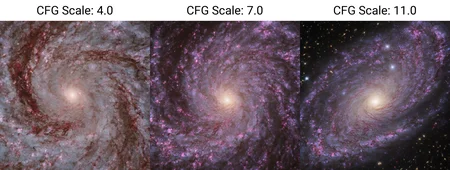
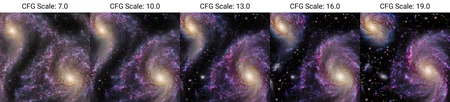
CFG has a key impact on the output. You can see it in the attached sample.
Enjoy.
Description
FAQ
Comments (7)
I love this LoRA and I can't wait to see just how far you can take us into the universe. Hoping for more angles in the future.
https://civitai.com/posts/2986702
Hum, I wonder whether galaxy zoo ever published their dataset, I recall getting some interesting stuff beside spirals back in the day.
I found a subpage called "All Galaxy Zoo Collections". Maybe a web crawling? But the resolution is a bit low.
Webb & Hubble are the best.
Neat. Looks like 424x424 was always the standard, though I never noticed; I only have two images that were 512x512, jfifs, not quite sure what was the difference in their cases (one seems to be a zoom out of a 424 which occupied ~256px in the center so maybe you could do that).
Well, I was just thinking in terms of the potential of endless masses of crowdsourced classification data, especially if given the chance for commentary since the layman might get more excited by what scientists perceive as mundane or noise (for example, my favourite in the collection is a "dragon shaped" galaxy, smooth cluster with a slightly irregular spiral arm & shape), but admittedly I haven't been involved with the field at all since ~15yrs ago when 1 & 2 were a thing. Just happened to be reminded of it by this model.
@firemanbrakeneck I'm not a pro, I just read "One of the pictures shows a galaxy stretched into a dragon shape in a cosmic illusion. It is a normal spiral galaxy, but its light rays get bent on their way to Earth due to the gravity of an intervening galaxy cluster in a phenomenon called gravitational lensing."
So basically the gragon shaped ones might be normal galaxies?
@PC12138 Really nice find, definitely better than mine. Neither am I, but I believe in many cases yes, known physical phenomena may account for whatever irregularities we spot (or at least provide a plausible explanation), where the basis is mundane. Nevertheless, I don't think that necessarily detracts from the "collector's value" of such finds, wouldn't you say?
Besides, strong gravitational lensing, as I recall, isn't all that common by itself.
@firemanbrakeneck yeah of course, everyone contributes aand every work is invaluable. The technique is developing thanks to a growing and dedicated fanbase. Just like AI.
The gravitational lensing was not so well known possibly due to the limitations of telescope resolution at the time. https://webbtelescope.org/contents/media/images/2022/035/01G7DDDR3P8ZW10HD8MKXGV8MJ With the Webb's vision, we can now see this phenomenon much more clearly, which could mean such phenomena are more than we thought. And since everthing's moving, we will inevitably find new ones over time. But yeah they are super rare on the scale of the universe. Who doesn't love a four-leaf clover?