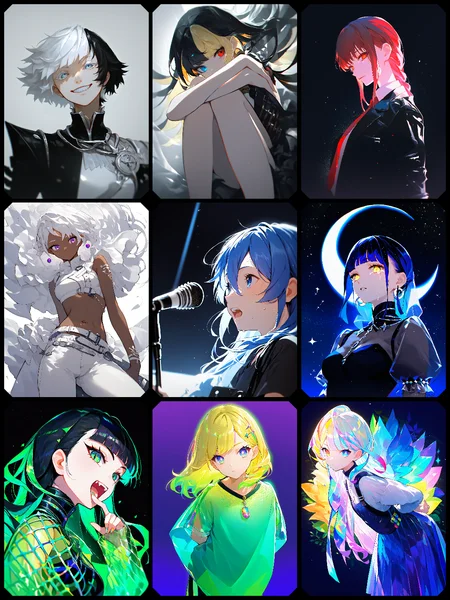

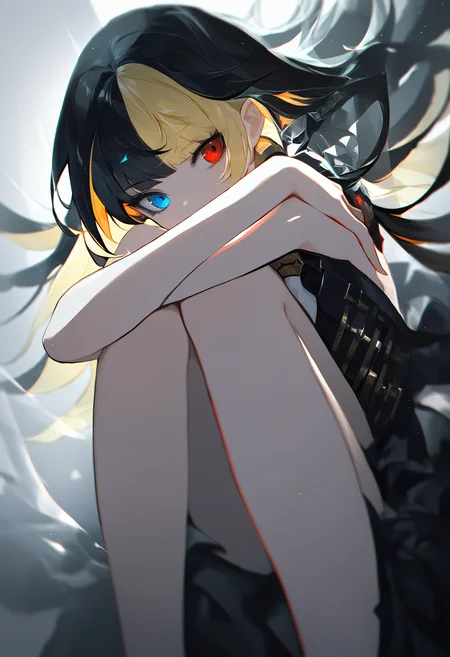




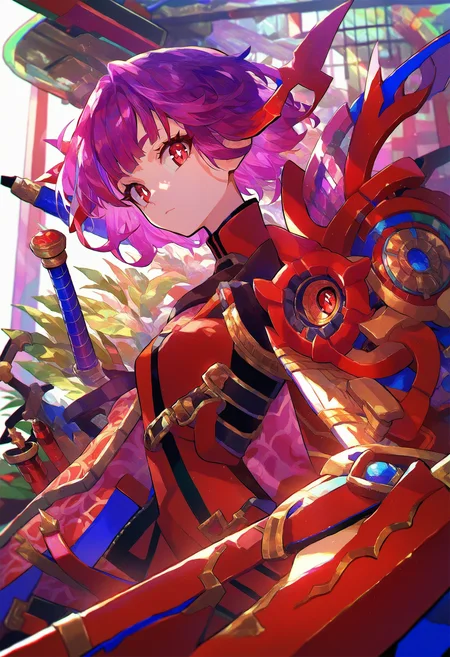
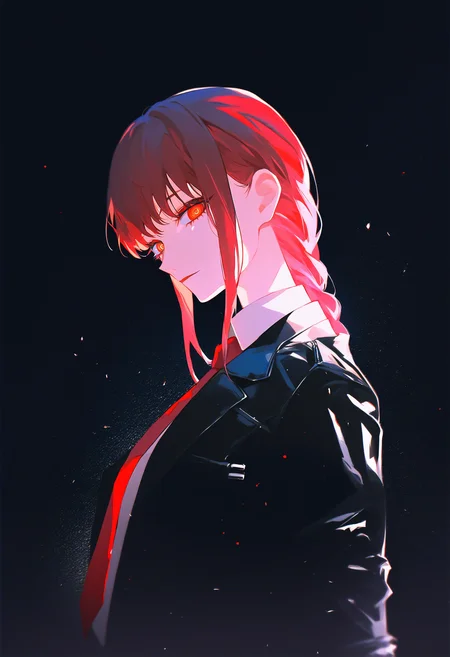
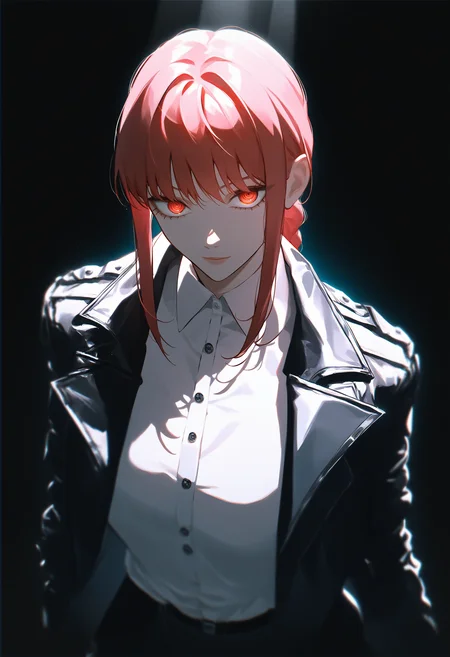




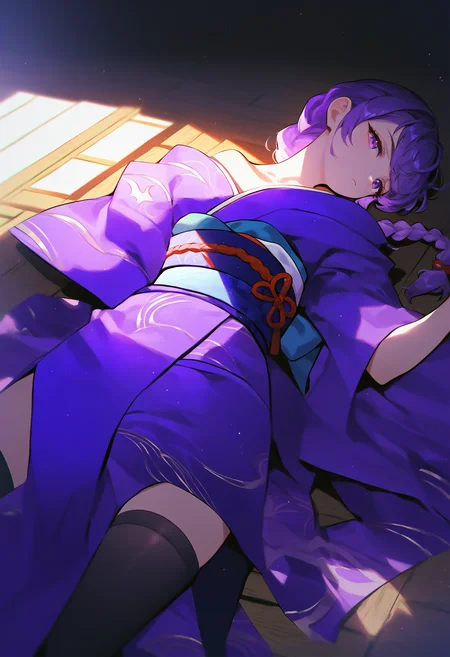
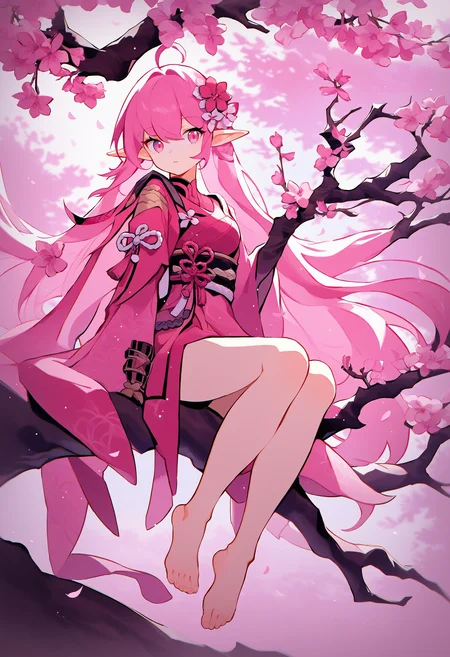


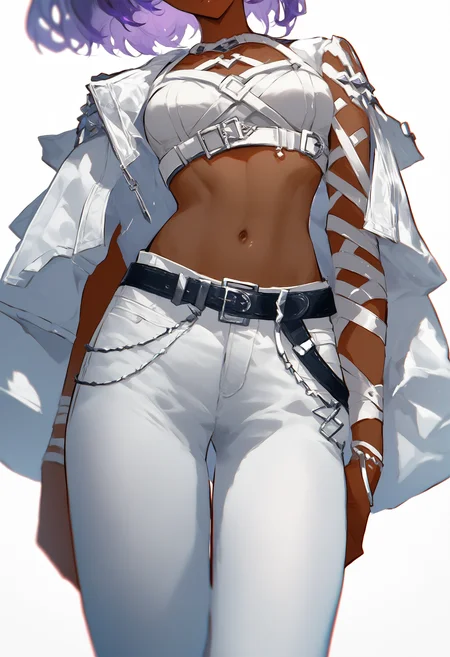
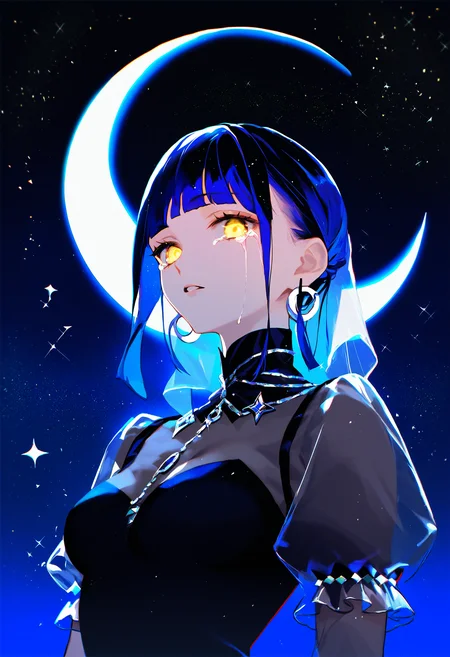
Color Theory (Study)
This is a small study on tagging color concepts in the context of artworks that make use of color theory.
I'm not an expert on any of these topics, just enjoying learning & sharing.
I've also used these as an comparative study on DoRA/LoRA training (I prefer the DoRA results).
Usage Guide:
These tags are already common Danbooru tags,
so applying some of the techniques here to other models might work for more aesthetic color compositions.
Color Harmony
Extreme unity leads to under-stimulation,
extreme complexity leads to over-stimulation.
Harmony is a dynamic equilibrium.
Analogous Colors
Analogous colors are any three colors which are side by side on a 12-part color wheel,
such as yellow-green, yellow, and yellow-orange.
Usually one of the three colors predominates.
Complementary Colors
Complementary colors are any two colors which are directly opposite each other,
such as red-green, red-purple and yellow-green.
Tagging:
For color triggers, theme/background should be interchangeable - but I gave more focus to theme tagging.
Color wheel (clockwise order):
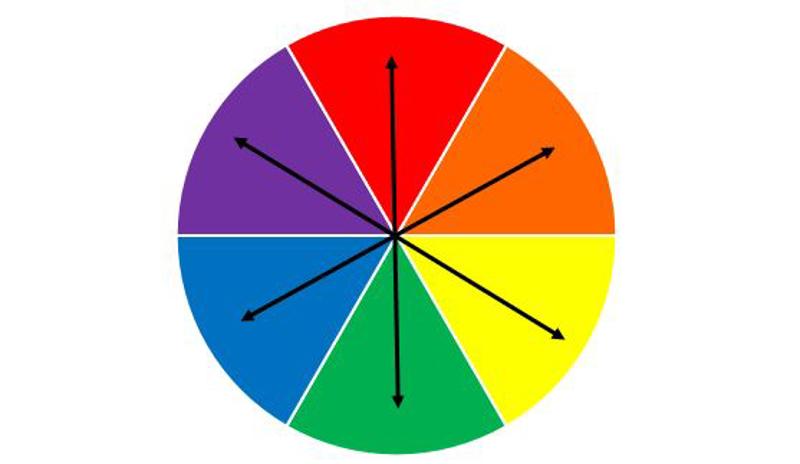
red theme
orange theme
yellow theme
green theme
blue theme
purple theme
Saturation:
colorful
high contrast
black theme
white theme
brown theme
grey theme
cyan theme
pink theme
Lighting:
light
light beams
dappled light
dark
shadow
Complementary Colors:
yellow, purple
orange, cyan
red, green
blue, orange
Composition:
spot color
scenery
simple background
gradient background
Three Color Palette:
For a 3 color palette, can aim to apply colors to the generation by the rule of thirds for a nice balance.
For a character focus, hair, eyes, accessories can work well for a 10% element.
A {color} theme works well for the 30% element.
And a {color} background works well for the remaing 60%.
Example combination:
green background, cyan theme, red eyesStepping through the color gamut of available tags with an X/Y plot on Prompt/SR:
green,yellow,orange

cyan,green,yellow

red,purple,blue
Selective Coloring:
Selective coloring is a photography technique where one color is prominent in the final shot whereas all the other colors have either been changed to monochrome or had their color saturation levels lowered.
White:
spot color, white theme, white backgroun, light, light beam, dappled light
Black:
spot color, black theme, dark, shadow
License
Description
This is a DoRA, not your typically made LoRA. A1111 v1.9.0 and up is required to use this. Forge users must download two files, which can be found here. Go to stable-diffusion-webui\ldm_patched\modules and replace the files there.
When used at strength 1, some artifacting occurs for certain prompts in Forge
Training settings:
DoRA training required updating the lycoris submodule:
https://github.com/bmaltais/kohya_ss/issues/2589#issuecomment-2171903484
Kohya training toml
bucket_no_upscale = true
bucket_reso_steps = 256
cache_latents = true
cache_latents_to_disk = true
caption_extension = ".txt"
clip_skip = 2
dynamo_backend = "no"
enable_bucket = true
epoch = 30
full_bf16 = true
gradient_accumulation_steps = 1
gradient_checkpointing = true
huber_c = 0.1
huber_schedule = "snr"
learning_rate = 1.0
logging_dir = "E:/work/LoRa_work/logging"
loss_type = "l2"
lr_scheduler = "cosine"
lr_scheduler_args = []
lr_scheduler_num_cycles = 1
lr_scheduler_power = 1
max_bucket_reso = 2048
max_data_loader_n_workers = 0
max_grad_norm = 1
max_timestep = 1000
max_token_length = 225
max_train_epochs = 30
max_train_steps = 3395
metadata_author = "motimalu"
min_bucket_reso = 512
min_snr_gamma = 5
mixed_precision = "bf16"
multires_noise_discount = 0.3
multires_noise_iterations = 6
network_alpha = 16
network_args = [ "preset=full", "conv_dim=1", "conv_alpha=1", "rank_dropout=0",
"bypass_mode=False", "dora_wd=True", "module_dropout=0", "use_tucker=False",
"use_scalar=False", "rank_dropout_scale=False", "algo=locon", "train_norm=False",]
network_dim = 32
network_module = "lycoris.kohya"
no_half_vae = true
noise_offset_type = "Multires"
optimizer_args = []
optimizer_type = "Prodigy"
output_dir = "D:/model_output"
output_name = "pony_color_theory_dora_v1"
pretrained_model_name_or_path =
"C:/workspace/webui_forge_cu121_torch21/webui/models/Stable-diffusion/ponyDiffusionV6XL_v6Start
WithThisOne.safetensors"
prior_loss_weight = 1
resolution = "1024,1024"
sample_every_n_epochs = 10
sample_prompts = "D:/model_output\\prompt.txt"
sample_sampler = "euler_a"
save_every_n_epochs = 30
save_model_as = "safetensors"
save_precision = "bf16"
seed = 339491249
text_encoder_lr = 1
train_batch_size = 6
train_data_dir = "C:/data/color_theory"
unet_lr = 1
xformers = true
FAQ
Details
Files
Available On (1 platform)
Same model published on other platforms. May have additional downloads or version variants.