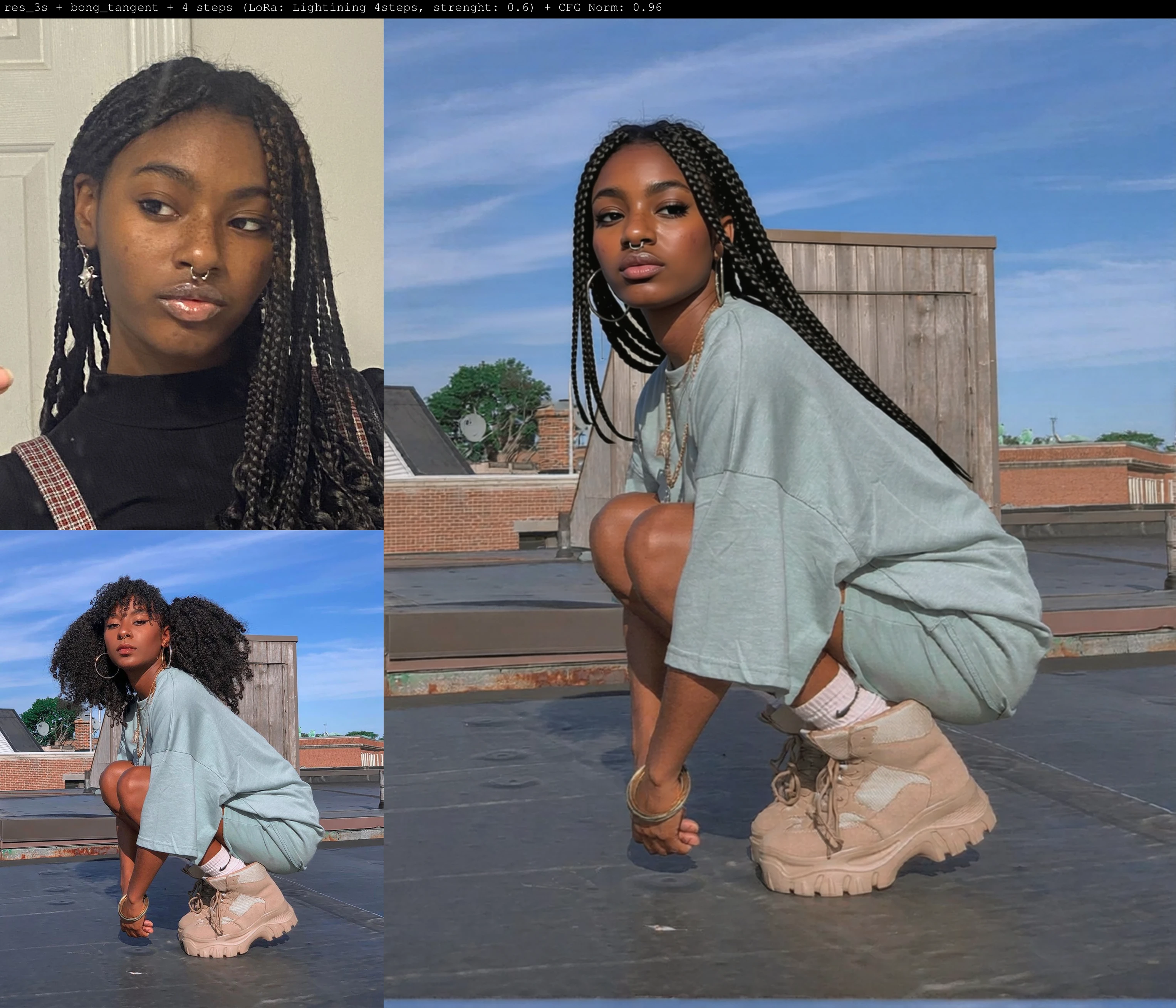
The BFS (Best Face Swap) LoRA series was developed for Qwen Image Edit 2509, specialized in high-fidelity face and head replacement tasks with natural tone blending and consistent lighting.
Each version builds upon the previous one:
- 🧠 V1 – Focus Faces: precise face swaps, keeping the original head shape and hair while transferring facial identity and expression.
- 🧩 V2 – Focus Head: stronger head swaps, replacing the full head (including hair and pose orientation).
- The 2 versions complement each other, one is focused on face swapping and the other is focused on head swapping.
Workflow can be downloaded here
Face Swap Video Tests:
Face Swap - Qwen Image Edit 2509 (English)
NOTE: If you are having results with a lot of contrast or very strong colors and plastic texture and are using the lightining models from lightx2v, try for example instead of using the number of steps equal to the model you selected from lightning, try using something like N / 2, for example if you select the lightning version Qwen Image Edit 2509 of 8 steps in the steps of the inference process, try using 4 steps, because the contrast problem is probably due to the excessive number of steps since the CFG is fixed at 1.0, now if you are having this problem without using the lightning lora then try reducing the number of steps for example instead of 20 try using about 16 or less, you will need to balance this according to your preferences, besides it is important to adjust the cfg to something smaller, for example 1.2, 1.5 and this can help you. Now, sometimes you may have a problem with the similarity issue, in cases where the image is very different in terms of poses and aesthetics, so it is interesting to try to increase the strength of the head swap lora, for example 1.2, 1.3.
⚙️ BFS V1 — “Focus Faces”
Trained on 240 image triplets (face, body, and result),
with a LoRA rank of 16 → later increased to 32,
and gradient accumulation = 2, running for 5500 steps on an NVIDIA L40S GPU.
This version produces stable and detailed face swaps, preserving expression, lighting, and gaze direction while maintaining the body’s natural look.
🔧 Model Notes
- You don't need to use my workflow to make this lora work, if you are having problems with it use yours, it is the simple workflow of qwen image edit + lora and the inputs in the right order: face image 1, body image 2.
- Quantization: not guaranteed to work below FP8 (avoid GGUF Q4).
- Face mask: optional — remove if MediaPipe or Planar Overlay cause issues.
- Pose conditioning: use MediaPipe Face Mesh or DWPose if you need more alignment control.
- Lightning LoRA: may produce plastic-like skin, especially when mixed with other Qwen-based LoRAs.
⚙️ Recommended Settings
Samplers:
- er_sde + beta57 / kl_optimal / ddim_uniform (best results)
- ddim + ddim_uniform (sometimes most realistic)
- res_2s + beta57
Don't get attached to one setting, sometimes if it doesn't work well with one, switch to another.
Precision:
- 🧠 Best: fp16
- ⚙️ Recommended: gguf q8 or fp8
- ⚠️ Below fp8: noticeable degradation
Inference Tips:
- With Qwen Image Edit 2509 Lightining LoRA → use 4 / 8 steps for fast generation.
- Without it → use 12–20 steps, CFG 1.0–2.5 for realism.
🧬 BFS V2 — “Focus Head”
The V2 “Focus Head” version was trained as a continuation of V1, extending the dataset and shifting focus toward full head swaps.
It was trained on a NVIDIA RTX 6000 PRO, rank 32, for 12,000 steps, using 628 image pairs (face, body, target, and sometimes pose maps generated via MediaPipe).
🔹 Training Phases
- Standard Face Swap – same as v1, focusing on facial identity.
- Pose-Conditioned Face Swap – added pose maps to align gaze and head angle.
- Full Head Swap – replaced the entire head (including hair) for stronger identity control.
After ~2000 steps, the focus moved toward head swap refinement.
At ~4000 steps, the dataset was narrowed to perfect skin-tone matches, and by the end of training,
the dataset evolved from 628 → 138 → 76 high-quality samples for final fine-tuning.
⚠️ Note:
While V2 can still perform standard face swaps, it’s more naturally inclined toward full head swaps due to its data balance.
This was intentional in part, but also a side-effect of dataset distribution and mixed conditioning.
Future versions aim to restore the fine facial control of V1 while keeping the strong tone and pose consistency of V2.
⚠️ Important Notice
Do not use or share results involving real people, celebrities, or public figures.
Civitai’s moderation may disable posts that violate likeness or consent rules.
This model is intended only for artistic and fictional characters, educational use, and AI experimentation.
I take no responsibility for any misuse of this model. Please use it responsibly and respect all likeness rights.
Description
This is an optional version that works nicely. It was trained with only a rank of 4, meaning the LoRa is much shorter and works well in my tests. Feel free to test it and post your results here; this helps improve this LoRa.
One of the big differences in this version is the order of the face and body inputs; now you need to send the body first and then the face, unlike other versions. This was a test I was doing and it ended up this way, so it's very important to keep this in mind. In the latent form, if you're going to pass an image, pass the body image or an empty latent form.
The trigger should be this: "head_swap: start with Picture 1 as the base image, keeping its lighting, environment, and background. remove the head from Picture 1 completely and replace it with the head from Picture 2. ensure the head and body have correct anatomical proportions, and blend the skin tones, shadows, and lighting naturally so the final result appears as one coherent, realistic person."
Note: Often the size of the head depends on the input image, so keep that in mind.
FAQ
Details
Files
Available On (9 platforms)
Same model published on other platforms. May have additional downloads or version variants.