


Official Forge Neo support
SnapRef now has an official Forge Neo extension, with BF16 and FP8 adapters, up to four reference images, per-reference Strength, Character / Character & Style modes, and Fidelity.
- In Forge Neo, open Extensions → Install from URL and paste
https://github.com/ArcAnima/SnapRef-Forge-Neo. - Click Install, then restart Forge Neo.
- Open the SnapRef panel, select the v2a BF16 or FP8 adapter, click Download, and add your reference images.
An Anima checkpoint, text encoder and VAE are required. Installation and update instructions.
SnapRef v2a
SnapRef v2a stable. Character reference, several views of one character, and per-reference weights.
See the examples and v1a / v2a evaluation.
Please support SnapRef! Developing these models has taken 400+ H100 GPU-hours so far.
If SnapRef is useful to you, a ⭐ on GitHub, sharing your results or
reporting issues helps a lot, and GPU sponsorship is very welcome.






Give Anima one picture of a character. Write only the scene.
Hair, eyes and outfit come from the reference and follow the new pose. The art style comes from the reference too,
or, with mode char, from the base model and your prompt.
Download weights · Quick start · Character styles · Multi-reference · Reference weights · Evaluation
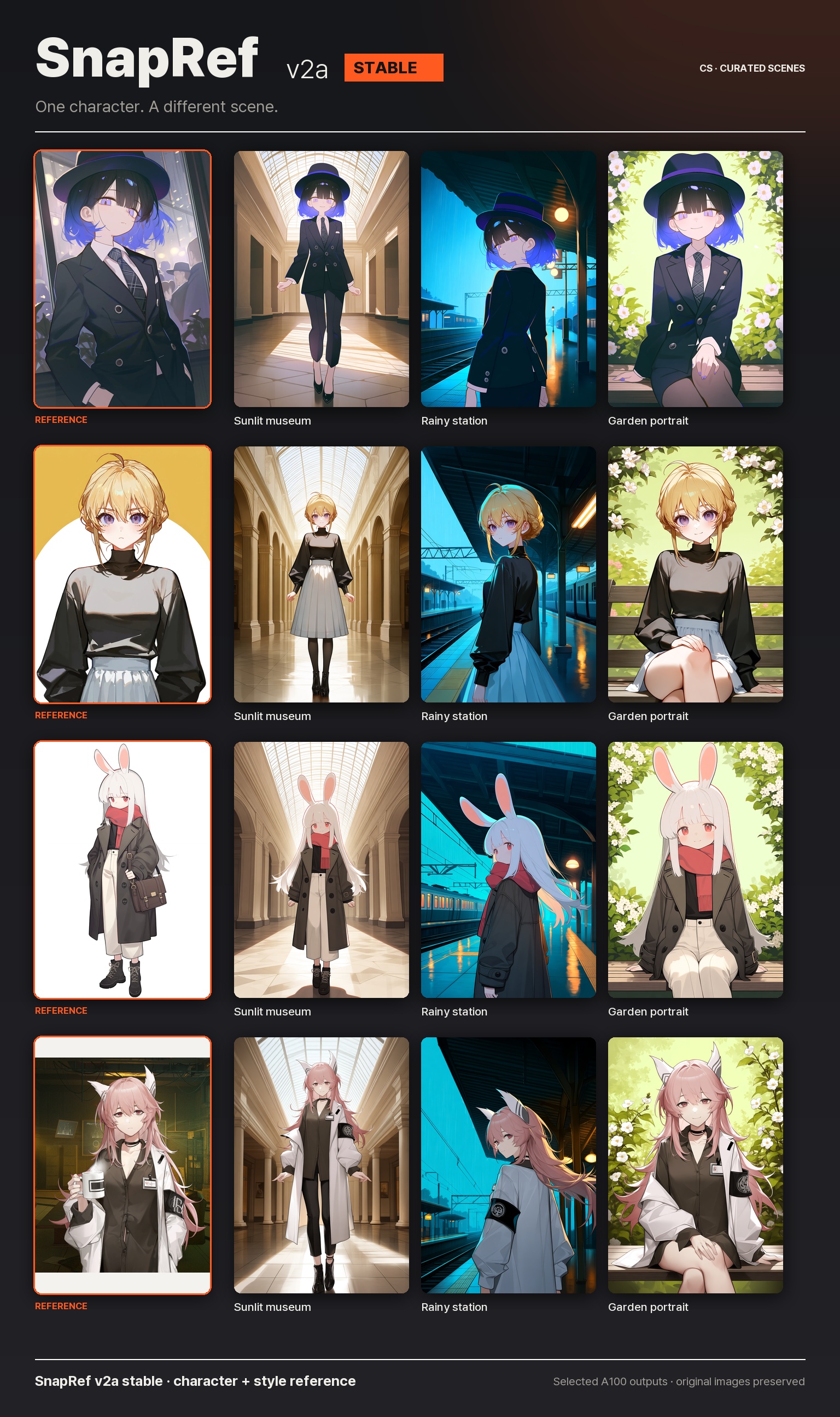
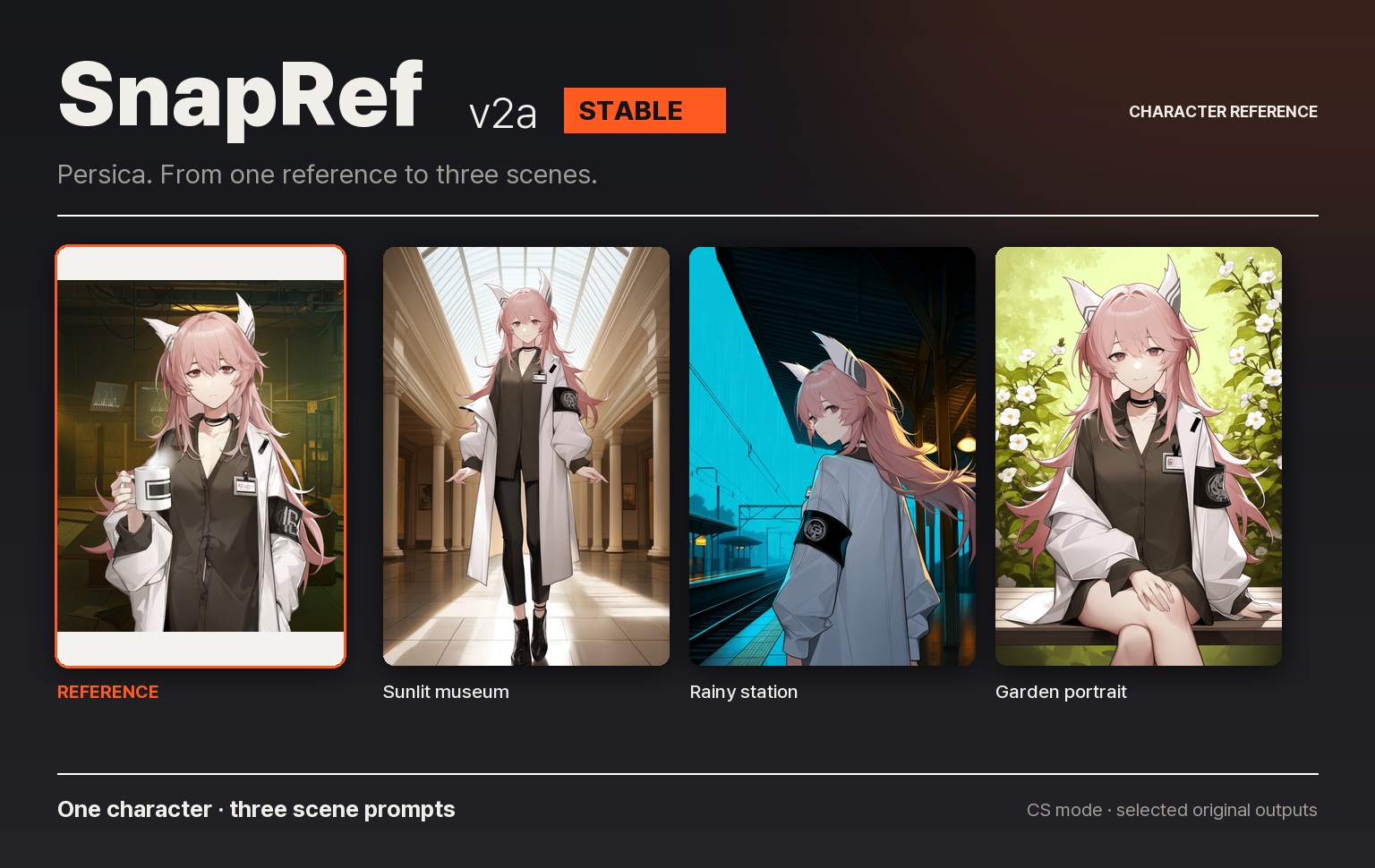
Four references, three scene prompts. Orange outlines mark the inputs. The prompts describe the scene, pose and lighting without character names or appearance tags.
What you can make
- 🎭 Character and scene: How to use it: Use Character & Style (
cs) to carry the reference's appearance and visual treatment into another setting. - 🎨 Character, your choice of style: How to use it: Use Character (
char) and add watercolor, retro anime or flat-color tags to the prompt. - 🧩 Several views of one character: How to use it: Combine a portrait with a full-body picture to provide more outfit and silhouette information.
- ⚖️ Per-reference weights: How to use it: Adjust each picture's contribution. Compare second-reference weights of 0.4 and 1.0 below.
The simple SnapRef node accepts up to eight pictures of the same character. SnapRef (Advanced)
exposes the reference layout, individual weights and additional controls.
Character styles
Keep the reference, change the style prompt. These examples use char mode with watercolor, 1990s anime
and flat-color treatments; the scene and seed stay the same within each row.
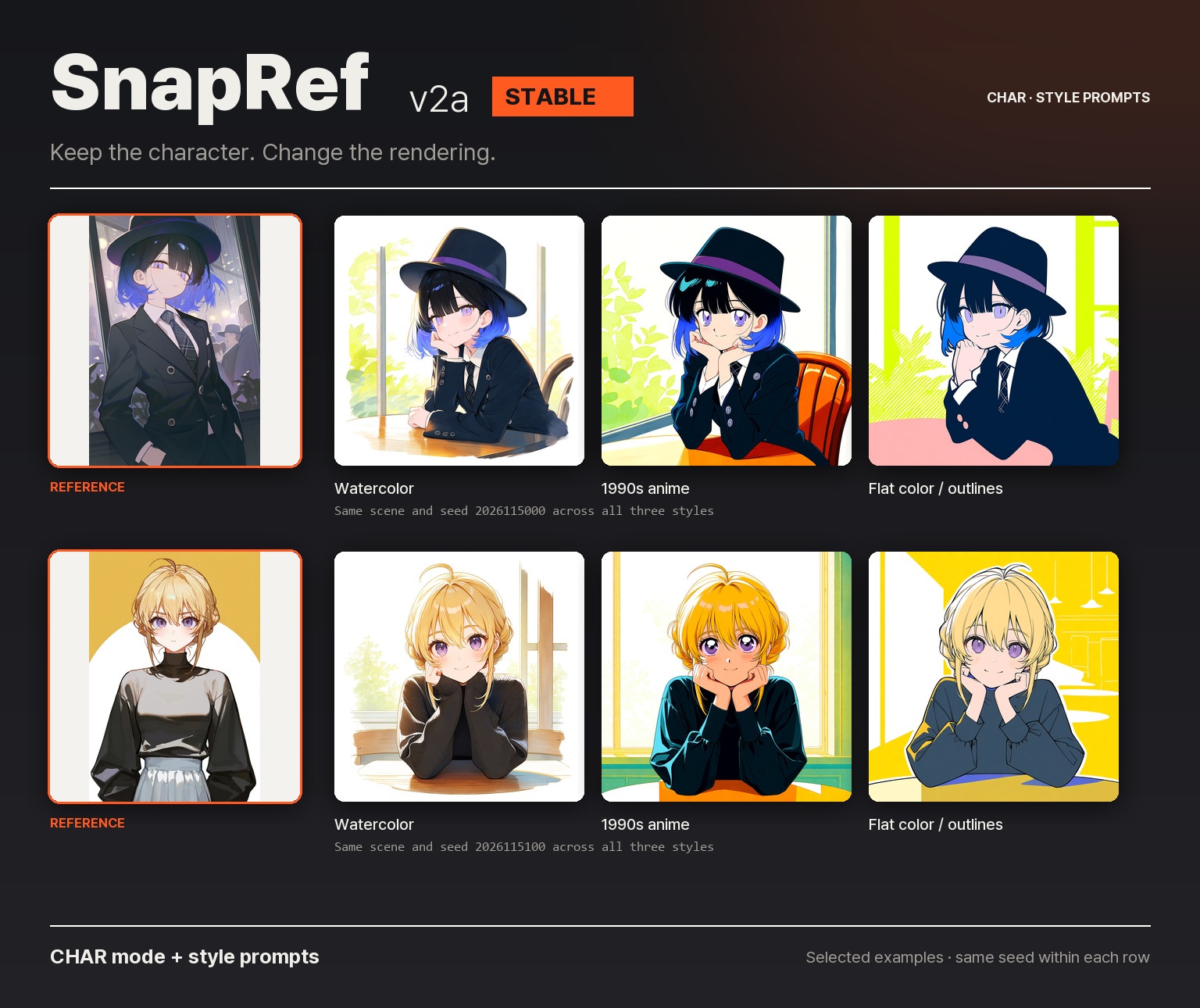
The reference supplies the character, while the style prompt changes the rendering. Fine details such as eyewear and collars can still vary.
Multi-reference
Use two pictures of the same character: one with a clear face and another showing the full outfit.
In separate layout, the references are encoded individually and used together during generation.
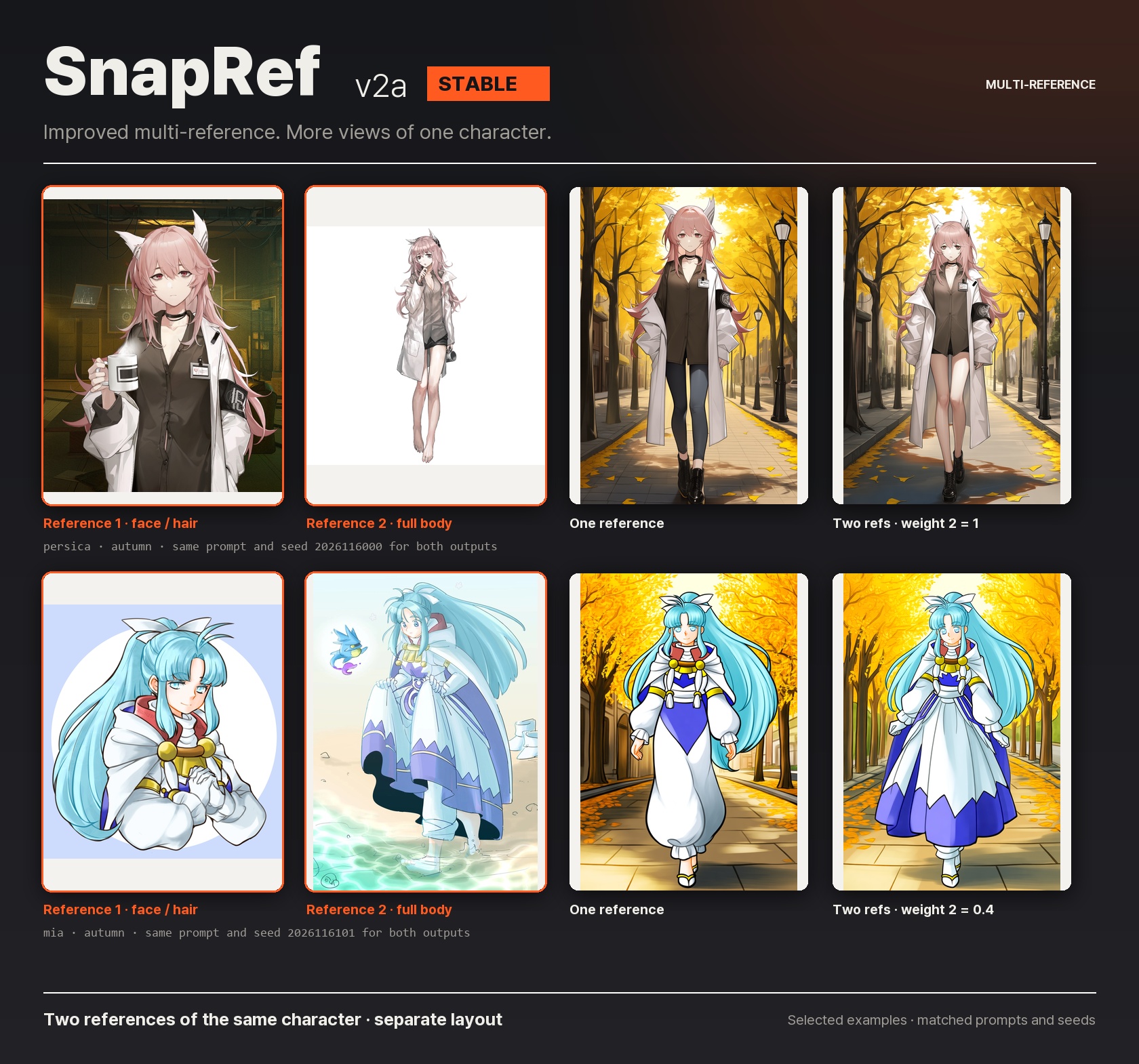
One reference versus two, with the same prompt and seed in each row. The second-reference weight is **1.0 for Persica** and **0.4 for Mia**. These are selected examples, not an aggregate improvement score.
The same pair, another scene
The same two pictures can guide a walking pose outdoors or a seated portrait in a study.
Keep solo in the prompt when you want one character.
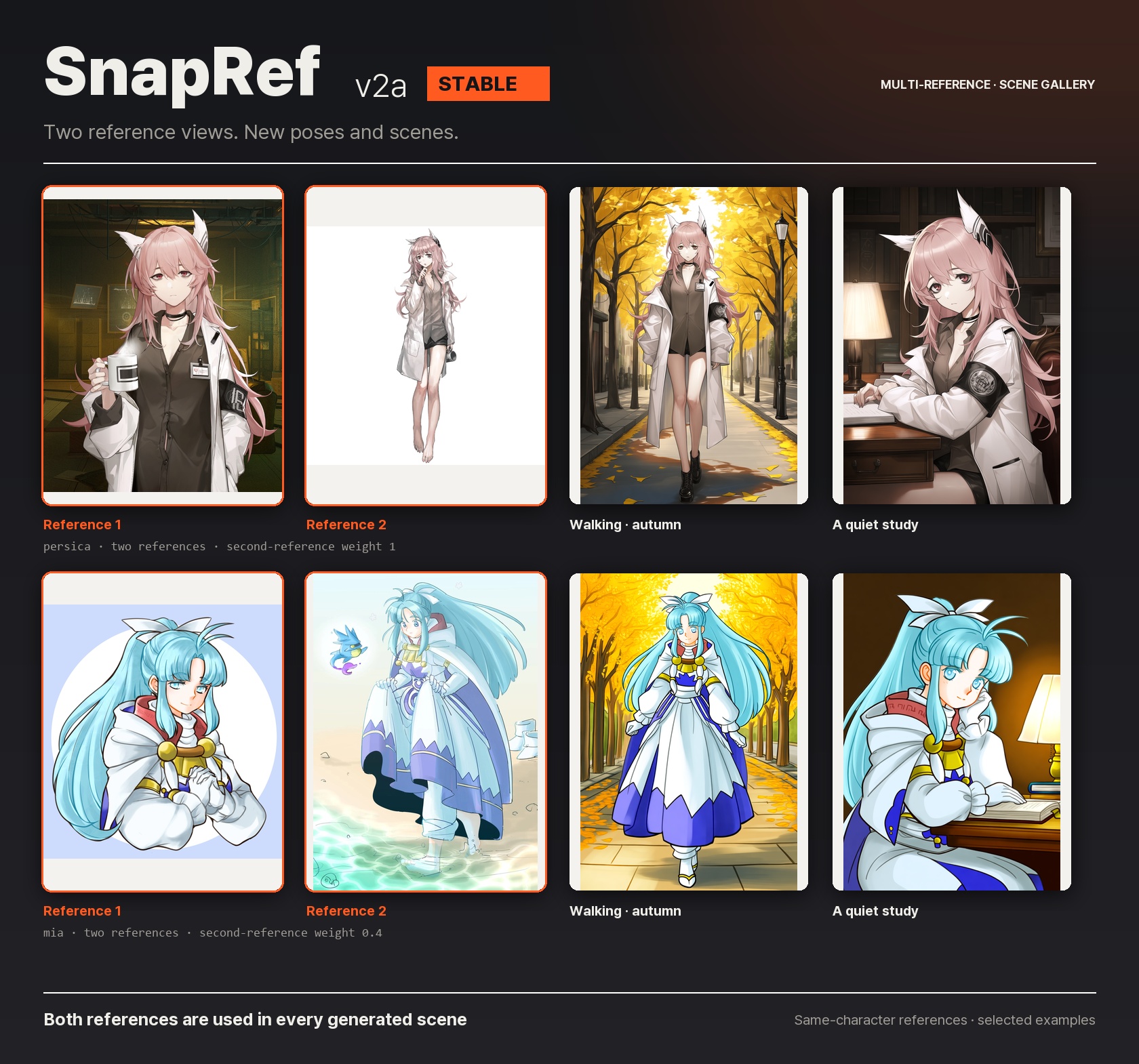
Both references contribute to every output. These scenes use independently selected seeds; the controlled one-versus-two comparison is the figure above.
Reference weights
Start with both weights at 1.0. If a second picture changes the look too much, try lowering its weight.
0.4 gives it a smaller contribution; 0 skips it. Per-reference weights apply in separate layout.
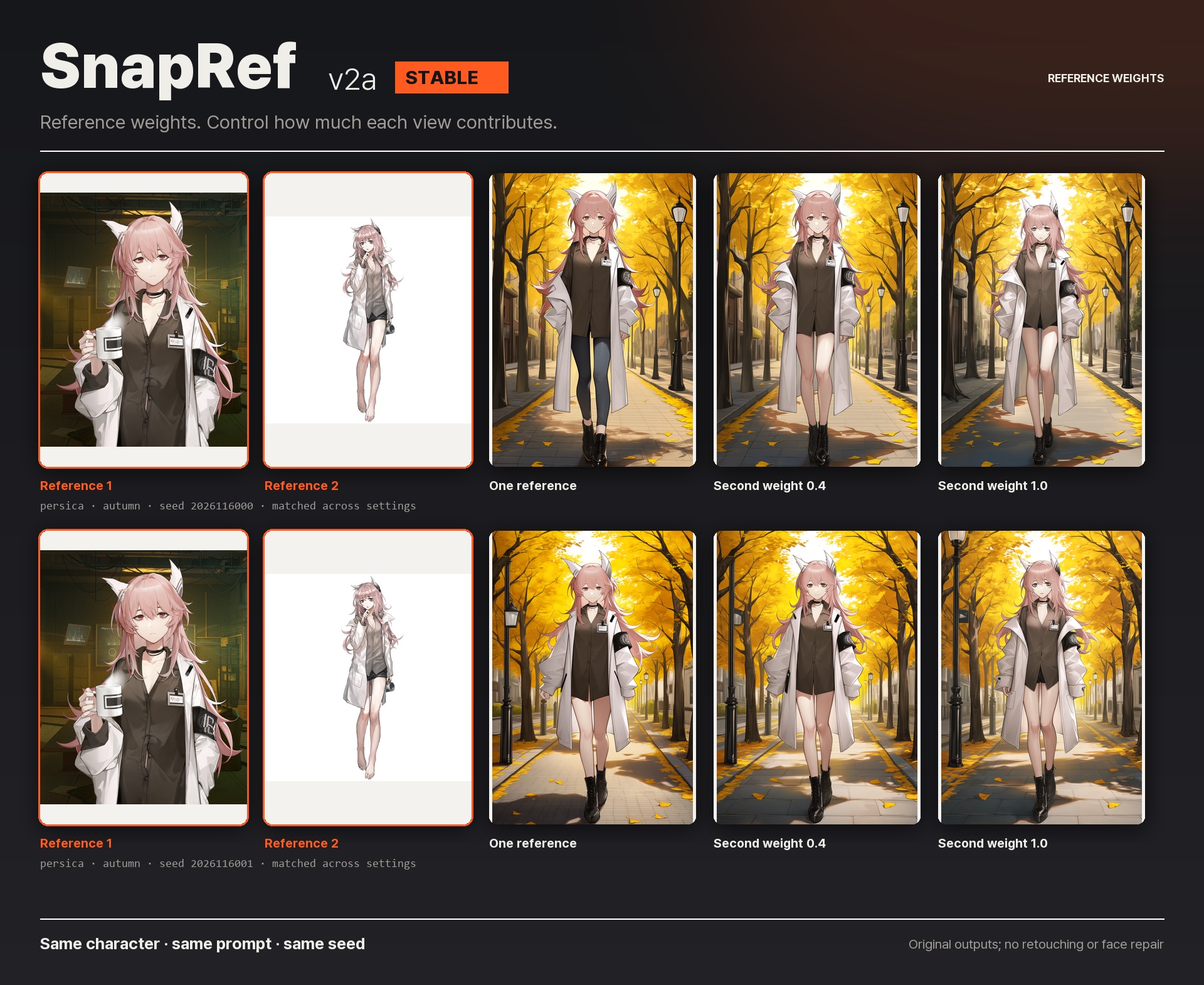
Each row keeps the prompt and seed fixed. The first-reference weight remains 1.0. Higher weight is not a guarantee of a better result.
More scenes
Persica, from a single reference
A museum atrium, a railway platform and a garden bench: different framing and lighting from one input.
After the rain
Three independent characters under the same scene prompt. Cool platform lighting and warm reflections
give the reference designs a different atmosphere.
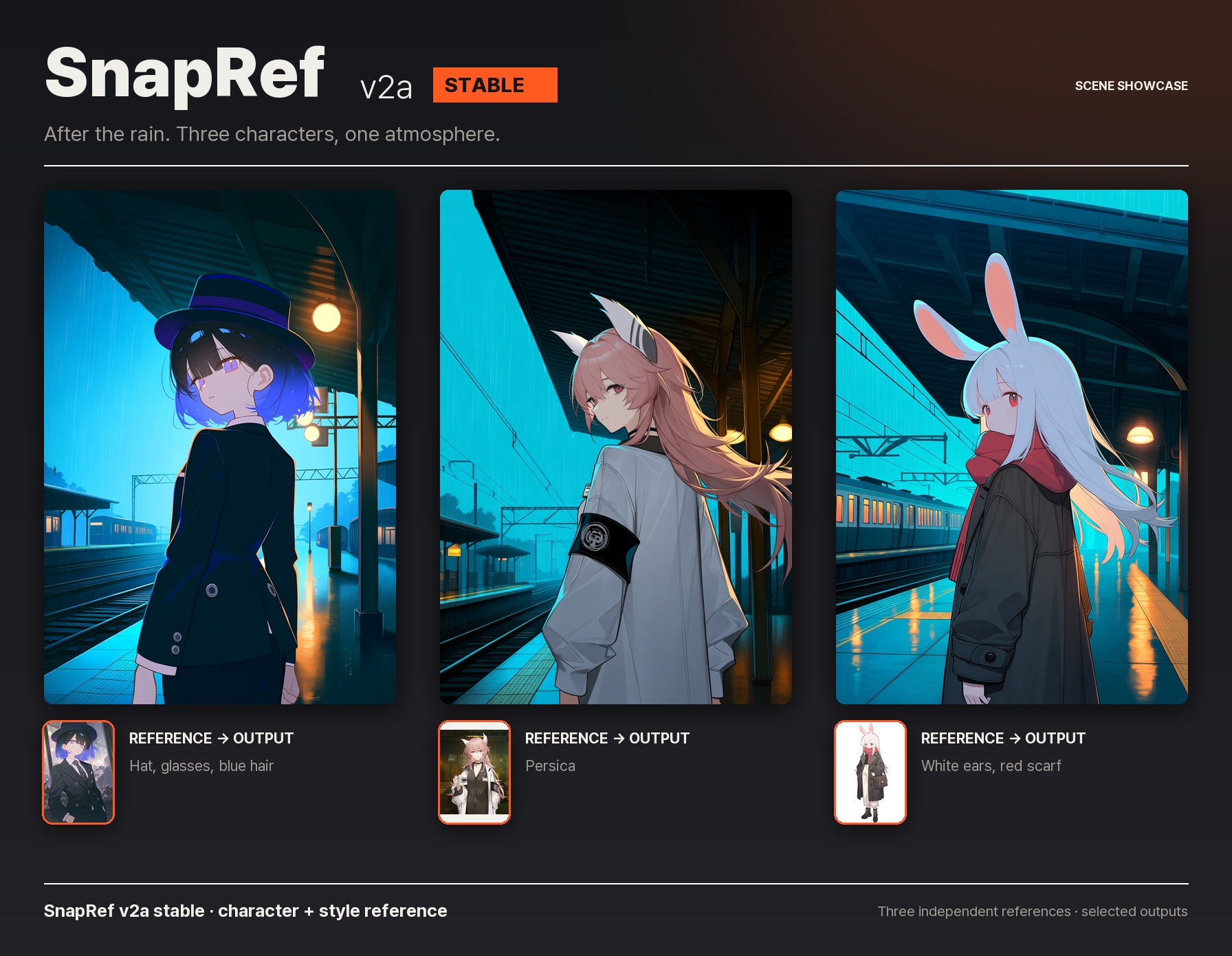
Selected examples generated with SnapRef v2a.
Quick start
- Install Anima base v1.0 with its text encoder and VAE in ComfyUI.
- Download and extract the node and workflows ZIP. Copy
comfyui/snapref/intoComfyUI/custom_nodes/snapref/, then restart ComfyUI. - Download
snapref_v2a.safetensorstoComfyUI/models/loras/. - Open
workflows/snapref_v2a_simple.json, choose your own reference image in the SnapRef node and queue. The adapter is already set tosnapref_v2a.safetensors.
Use an up-to-date ComfyUI installation. If your base-model, text-encoder or VAE filenames differ, select
the installed files in the loader nodes. In the advanced workflows, choose a picture in each Load Image node.
Try a scene-only prompt like this:
masterpiece, best quality, score_7, safe, 1girl, solo, sitting on a wooden garden bench,
looking at viewer, gentle smile, dappled sunlight, flowering trees
Choose the mode before writing style tags. Use Character & Style for the reference's look,
or Character to try another rendering style. In the simple node, fill two picture slots and
click + beside Character to add more views.
SnapRef uses its own node. Loading these weights through LoraLoader or a generic Diffusers
pipeline is not supported.
Workflows
All six workflows are included in the node and workflows ZIP.
- Simple: Use: Pick images inside the SnapRef node; Character & Style, Strength and Fidelity.
- Single reference: Use: SnapRef (Advanced) with a separate image input.
- Character mode: Use: Take the character from the reference and set the style in the prompt.
- Multi-reference: Use: Two views of the same character.
- Reference weights: Use: Two references with the second weight set to 0.4.
- Two characters: Use: Stitch references side by side and describe two characters in the prompt.
Settings
The showcased images use CFG 4.5 · Euler / simple · Fidelity 1.0 on Anima base v1.0.
- Adapter: Starting point:
snapref_v2a.safetensors; Purpose: Select the v2a stable weights. - Mode: Starting point: Character & Style; Purpose: Use Character when the prompt should set the rendering style.
- Strength per picture: Starting point:
1.0; Purpose: Contribution of that reference;0disables it. - Fidelity: Starting point:
1.0; Purpose: Lower values allow more prompt freedom.
SnapRef (Advanced) settings
mode: Starting value:cs; Purpose:cs: character and style;char: character with prompt-driven styling.strength: Starting value:0.0; Purpose: Global reference attention on a log scale; different from the simple node's per-picture Strength.fidelity: Starting value:1.0; Purpose: Ignored whenref_in_uncondorref_guidance_onis enabled.ref_megapixels: Starting value:1.0; Purpose: Maximum area of each encoded reference; smaller images are not enlarged.ref_caption: Starting value: empty; Purpose: Optional reference appearance tags.ref_in_uncond: Starting value: off; Purpose: Keep the reference out of the negative branch at the showcased default.ref_guidance_on: Starting value: off; Purpose: Additional reference guidance; the figures use it disabled.image_2,image_3: Starting value: optional; Purpose: Additional images of the same character.use_batch: Starting value: off; Purpose: Read multiple images from an IMAGE batch.multi_layout: Starting value:separate; Purpose: Encode references independently.stitchcombines them into one image.weight_1…weight_3: Starting value:1.0; Purpose: Per-reference contribution inseparatelayout.
How it compares
The fixed evaluation contains 64 cases × 2 seeds, separate from the curated figures above.
- Appearance tag recall ↑: v1a: 0.8722; v2a: 0.8727
- Extra appearance tags ↓: v1a: 0.1341; v2a: 0.1401
- Head SigLIP similarity ↑: v1a: 0.8989; v2a: 0.8903
- Head DINO similarity ↑: v1a: 0.7431; v2a: 0.7407
- Head CCIP distance ↓: v1a: 0.0684; v2a: 0.0715
- Full-image CCIP distance ↓: v1a: 0.0725; v2a: 0.0757
Appearance-tag recall improves slightly, while our qualitative assessment shows substantially better
reference following than v1a. A remaining issue is that the model can struggle to reproduce facial
details when the face in the reference image is very bright.
The metrics are sensitive to framing, pose, lighting and head detection.
Things to watch for
- Small accessories, collar shapes and fine patterns can change, especially with a strong style prompt.
- An upper-body reference does not define unseen lower-body clothing; a second full-body view can help.
- Artwork text or signature-like marks can be copied from a reference. Inspect outputs before sharing them.
Release details
- Release: SnapRef v2a stable
- Base used for these examples: Anima base v1.0
- Weight file:
snapref_v2a.safetensors - File size: 381,821,960 bytes, approximately 382 MB
Files
Download the node and workflows ZIP alongside the weights. It includes every file below except the model weights.
snapref_v2a.safetensors: Contents: v2a stable adapter weights.- comfyui/snapref/: Contents: SnapRef and SnapRef (Advanced), including the image-picker interface.
- workflows/: Contents: Six ComfyUI workflows configured for v2a.
- figures/: Contents: Release figures and hero preview.
- SHA256SUMS: Contents: Checksums for the weights and release files.
- LICENSE.md · NOTICE.txt: Contents: Weight license and attribution.
License
The weights are a derivative of the CircleStone Model and use the CircleStone Labs Non-Commercial
License v1.2 (LICENSE.md, NOTICE.txt). Non-commercial use only.
SnapRef is not affiliated with or endorsed by CircleStone Labs.
The CircleStone Model is licensed by CircleStone Labs LLC under the CircleStone Non-Commercial License. Copyright CircleStone Labs LLC.
IN NO EVENT SHALL CIRCLESTONE LABS LLC BE LIABLE FOR ANY CLAIM, DAMAGES OR OTHER LIABILITY, WHETHER IN AN ACTION OF CONTRACT, TORT OR OTHERWISE, ARISING FROM, OUT OF OR IN CONNECTION WITH USE OF THIS MODEL.
Modification notice: snapref_v2a.safetensors (SnapRef v2a stable) is a derivative of the
CircleStone Model (Anima base v1.0). It contains trained adapter weights that modify the
model behavior when applied. It is not an official product of CircleStone Labs LLC and is not
endorsed, approved or validated by it.
Anima base v1.0 is a Derivative Model of NVIDIA Cosmos-Predict2-2B-Text2Image and is subject to the NVIDIA Open
Model License Agreement insofar as it applies to Derivative Models.
These weights are distributed under the CircleStone Non-Commercial License (LICENSE.md). Your rights to use the
CircleStone Model and this derivative come directly from CircleStone Labs LLC under that license.
THE WEIGHTS ARE PROVIDED "AS IS", WITHOUT WARRANTY OF ANY KIND; IN NO EVENT SHALL THE AUTHOR OR CIRCLESTONE LABS
LLC BE LIABLE FOR ANY CLAIM, DAMAGES OR OTHER LIABILITY ARISING FROM THEIR USE.
Description
Preview (step 15,000 of the v2a run). Try this one first among the previews. The new Character mode takes the character from the picture and leaves its art style behind, so the base model and your prompt set the style. In Character & Style mode it is close to v1a but not better; v1a stays the recommended version for everyday use.
LoRA rank 128 / 64, 382 MB (FP8 195 MB). Needs the SnapRef node from the attached ZIP (a LoRA loader will not work). Open workflows/snapref_v2a_pre2_simple.json, pick the picture inside the SnapRef node and write only the scene.